Product inquiries, order follow-ups, support tickets, appointment requests, complaints, reorders. Customers expect responses within minutes. But your team is four people sharing one phone, passing it back and forth, then accidentally double-replying to some customers and completely missing others.
Sound familiar? This is the WhatsApp growing pain that businesses across Malaysia, Singapore, the Philippines hit the moment they start taking customer messaging seriously. WhatsApp works brilliantly for small operations. But the moment volume picks up, the standard setup breaks down fast. WhatsApp multi agent is the solution.
What Is WhatsApp Multi Agent?
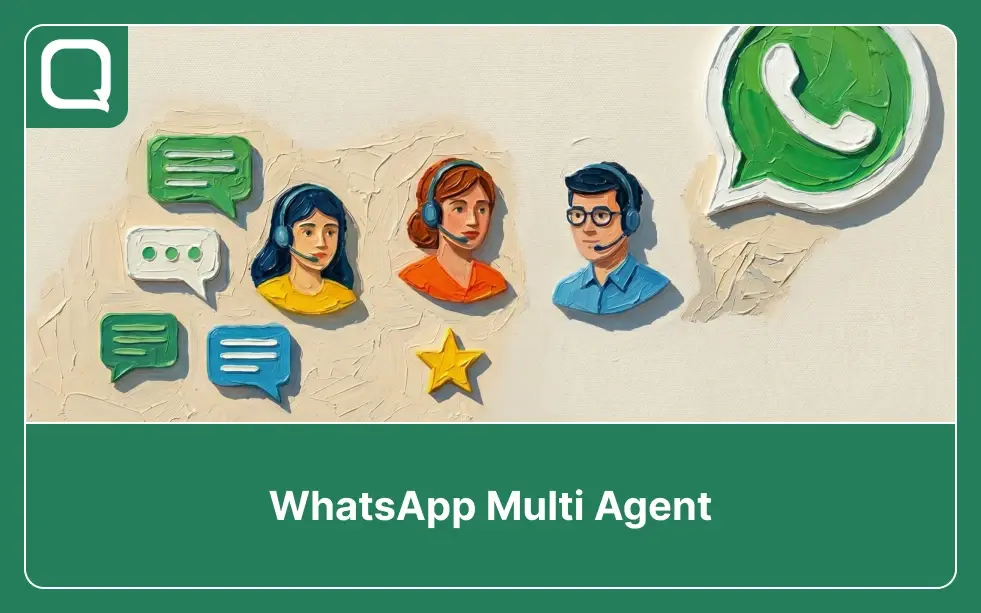
WhatsApp multi agent refers to a setup where multiple team members can simultaneously access, respond to, and manage conversations from a single WhatsApp Business number, through a shared platform.
Here’s the critical distinction: WhatsApp’s standard Business App supports up to five linked devices, but all those devices share the same view without any coordination layer. There’s no assignment, no ownership, no visibility into who’s handling what. As a result, two agents can reply to the same customer simultaneously. A high-priority lead can sit unread for hours because everyone assumed someone else would pick it up.
True WhatsApp multi agent capability requires access to the WhatsApp Business API and a third-party platform that provides a proper shared inbox with conversation routing, agent assignment, and performance visibility.
This is what separates a band-aid solution from a real operational upgrade.
Why the Standard WhatsApp Business App Isn’t Enough
The WhatsApp Business App was designed for small businesses: a solo founder, a two-person team, a shop owner managing customer chats between orders. For that context, it works perfectly fine.
But the moment a business grows beyond a handful of people and starts receiving dozens or hundreds of conversations a day, the App’s structural limitations become impossible to ignore. What feels like a minor inconvenience at low volume becomes a full operational breakdown at scale. Here’s exactly what breaks down.
1. No Conversation Ownership
Without an assignment system, every incoming message is visible to all agents, but no one is formally responsible for it. This creates two simultaneous failure modes: conversations that get double-handled (wasting time and confusing customers) and conversations that get ignored entirely because each agent assumes another person is on it.
2. No Routing Logic
Not every conversation should go to the same agent. Sales inquiries should reach the sales team. Technical issues should reach support. VIP customers should reach account managers. Unfortunately, the standard WhatsApp Business App has no mechanism to make this happen automatically. Every message hits the same inbox and relies on human judgment to route it — which fails under volume.
3. No Performance Visibility
Who responded fastest? Which agent closed the most conversations? What’s the average first-response time? These are basic management questions that the WhatsApp Business App simply cannot answer.
Without visibility into team performance, managers can’t identify bottlenecks, recognize high performers, or make informed decisions about staffing.
4. No Conversation History Across Handoffs
When a customer who spoke to Agent A last week contacts the business again and gets Agent B, Agent B has no context. They start from scratch. The customer has to repeat themselves. This is one of the most frustrating experiences in customer service and it’s structurally built into the standard WhatsApp Business setup.
5. The Scaling Wall
Ultimately, these limitations aren’t just inconveniences. They represent a genuine ceiling on how much volume a team can handle without operational chaos. Businesses that hit 50, 100, or 500 daily WhatsApp conversations on a standard setup are actually starting to actively fail their customers.
WhatsApp Business App was never built to coordinate a team, manage a pipeline, or deliver consistent service at scale. That’s precisely why businesses that are serious about using WhatsApp as a revenue and service channel need to move beyond the App and into a proper omnichannel platform.
How WhatsApp Multi Agent Actually Works
Many businesses assume that “multi agent” simply means more people logged into the same WhatsApp account. It doesn’t. When implemented properly through the WhatsApp Business API and a dedicated platform, the operational experience is fundamentally different from anything the standard app can offer.
Here’s what it actually looks like:
1. Shared Inbox with Individual Agent Visibility
All incoming WhatsApp messages land in a centralized inbox that every authorized agent can see, but conversations are assigned to specific agents, creating clear ownership. An agent sees their own assigned conversations, while supervisors see all conversations across the team.
2. Automated and Manual Routing
Conversations can be automatically routed based on rules: keyword triggers, customer tags, time of day, or previous agent assignment. For instance, a customer who last spoke to a specific sales rep can be automatically routed back to that rep. Similarly, a conversation that comes in after hours can be automatically assigned to an on-call agent or a chatbot. Manual routing is also available, supervisors can reassign conversations based on workload, urgency, or expertise.
3. Full Context on Every Conversation
Every agent has access to the complete conversation history with each customer, regardless of which agent handled previous interactions. Furthermore, agents can add internal notes visible only to the team, providing handoff context without cluttering the customer-facing chat.
4. Real-Time Supervision and Reporting
Managers get live dashboards showing queue depth, response times, agent workload, and SLA compliance. As a result, this visibility enables proactive intervention when a specific agent is overloaded or a conversation is approaching a response-time breach.
5. AI + Human Hybrid
Additionally, multi-agent platforms allow businesses to deploy an AI chatbot as the first line of response before routing to a human agent for more complex conversations. This dramatically increases the effective capacity of the human team.
Taken together, these capabilities transform WhatsApp from a messaging app into a structured, manageable customer communication channel. The coordination layer is what makes the difference and it’s what unlocks the commercial benefits that proper multi-agent WhatsApp actually delivers.
The Real Business Benefits of WhatsApp Multi Agent
It’s easy to focus on the operational mechanics of multi-agent WhatsApp. But the reason businesses invest in this platform is commercial impact. Moving beyond the technical, here’s what WhatsApp multi agent actually delivers when it’s working the way it should.
1. Faster Response Times
Response speed is one of the most significant drivers of conversion in conversational sales. And when a lead sends a WhatsApp inquiry and gets a response within two minutes, conversion rates are dramatically higher than when the same lead waits 30 minutes or more.
Multi-agent routing ensures no inquiry sits unattended and consequently, faster responses translate directly to more closed deals.
2. Higher Team Capacity Without Linear Headcount Growth
One of the counterintuitive benefits of proper multi-agent tooling is that it increases the effective capacity of the team without requiring proportional headcount increases. Specifically, automation handles the repetitive, low-complexity interactions. Human agents, therefore, focus on the conversations that genuinely require judgment, empathy, or negotiation. The ratio of value-generating interactions per agent hour improves significantly.
3. Consistent Customer Experience
When every agent has full conversation history, context notes, and access to a shared knowledge base, then customer experience becomes consistent regardless of which agent handles a given interaction. This consistency is what builds the trust that drives repeat purchases and referrals.
4. Scalable Customer Support
For businesses in Malaysia, the Philippines, and Singapore handling seasonal demand spikes, multi-agent WhatsApp means support capacity can flex with demand.
In conclusion, these benefits compound over time. Faster responses build a reputation for reliability. Higher capacity means more customers served without burnout. Consistent experiences earn repeat business. And scalability means growth doesn’t have to come with proportional cost increases.
WhatsApp Multi Agent Use Cases: How Real Businesses Are Using It
The best way to understand what WhatsApp multi agent makes possible is to look at how it’s being used by real businesses across industries. However, the common thread across every example below is the discipline of treating WhatsApp as a structured business channel rather than a personal messaging app.
Here’s what that looks like in practice.
1. E-Commerce: Managing High-Volume Order Inquiries (Malaysia & Philippines)
Online fashion retailers running on platforms like Shopee and Lazada in Malaysia and the Philippines receive hundreds of WhatsApp inquiries daily during campaign periods, such as sizing questions, tracking requests, return policies, and bulk order quotes.
With a single WhatsApp number and a multi-agent platform, their customer service team of 10 agents each handles an assigned queue. A chatbot handles the first touch before routing to the appropriate agent.
As a result, response times drop from 45 minutes to under 5. Customer satisfaction scores improve measurably.
2. Healthcare: Appointment Management Across Multiple Clinics (Singapore & Philippines)
Private hospital groups and multi-location clinic chains in Singapore and Metro Manila face a specific version of the multi-agent problem: they have multiple locations, each with their own staff, but want to present a single WhatsApp number to patients.
With multi-agent routing based on patient location or preferred clinic, every appointment request, follow-up query, or test result inquiry reaches the right team member at the right location, automatically.
Consequently, patients never have to navigate different numbers for different locations.
3. Financial Services: Lead Management and Advisor Routing (Malaysia & Singapore)
Insurance companies and wealth management firms in Malaysia and Singapore use WhatsApp multi agent to manage the handoff between marketing-generated leads and licensed advisors.
A lead initiated through a Click to WhatsApp ad is first greeted by a chatbot that collects basic qualifying information, such as age, coverage interests, and budget range, before being routed to an available licensed advisor based on their specialization and current workload.
As a result, no lead sits in a queue waiting for a human to manually read and assign it.
4. Retail & Automotive: Dealership Inquiry Management (SEA)
Automotive dealership groups across Southeast Asia use WhatsApp multi-agent setups to route inquiries by model interest, location, and sales rep availability. A prospective buyer asking about an SUV model gets routed to a specialist for that vehicle range.
Moreover, a buyer who previously interacted with a specific sales consultant gets routed back to the same person. This continuity drives significantly higher conversion rates on high-ticket purchases.
5. SaaS & B2B: Sales Team Coverage with CRM Integration (US & SEA)
B2B SaaS companies targeting SMBs in Singapore and the US use WhatsApp multi agent to manage inbound sales conversations during trial periods. When a trial user sends a WhatsApp question, the message is automatically associated with their CRM record and routed to their assigned account executive.
The team then sees the customer’s trial activity, plan tier, and previous conversation history before responding. Transforming what could be a generic support interaction into a high-context sales conversation.
Across every one of these examples, the outcome is the same: more conversations handled, fewer leads lost, and a better experience for the customer.
Then, the next question most businesses ask after seeing these use cases is: “what’s stopping us from doing the same?” Often, the answer is a reliance on workarounds that feel like solutions but aren’t.
WhatsApp Multi Agent vs. Single-Number WhatsApp: A Comparison
Before committing to a proper omnichannel platform, most businesses go through a phase of trying to solve the problem with what they already have. This is understandable, single-number WhatsApp setups are free, familiar, and feel like they should work.
Here’s an honest look at the most common ones, what they actually deliver, and where each one breaks down.
1. Multiple phone numbers, one per team: Gives each team their own WhatsApp presence, but fragments the customer experience. Customers don’t know which number to contact. Conversation history is siloed. Management has no consolidated view.
2. WhatsApp Web on multiple computers: All agents share the same login. There’s no assignment, no routing, no performance tracking. Double-handling and missed conversations happen constantly.
3. WhatsApp Business App linked devices (up to 5): Slightly better than shared login, but still no coordination layer. Useful for very small teams with low volume. However, it breaks down quickly as volume grows.
4. WhatsApp Business API + multi-agent platform: The only solution that provides real routing, assignment, history, and reporting. Requires setup through a BSP (Business Solution Provider), but ultimately delivers the operational system that actually scales.
However, the pattern is consistent: every workaround trades short-term convenience for long-term operational debt. They feel like solutions until the volume arrives — and then they fail at exactly the moment you need them most.
The businesses that scale WhatsApp effectively are, therefore, the ones that skip the workaround phase and build on the right foundation from the start.
How Qiscus Powers WhatsApp Multi Agent for Growing Businesses
Rather than patching the problem with workarounds, Qiscus gives businesses the complete infrastructure stack to run WhatsApp multi agent properly — from API access and chatbot automation, all the way through to CRM integration and real-time analytics.
1. WhatsApp Multi-Agent Inbox
Qiscus Omnichannel Chat provides a centralized inbox that unifies WhatsApp alongside Instagram, Facebook Messenger, LINE, Telegram, and 20+ other channels. Every incoming WhatsApp conversation is visible to the full team, but individual conversations are assigned to specific agents with clear ownership.
Moreover, supervisors get a live view of the entire queue — who’s handling what, how long conversations have been open, and where the bottlenecks are.
Routing rules can be configured based on keywords, customer tags, time of day, campaign source, or previous agent assignment — giving businesses granular control over how conversations flow through the team.
2. AI Chatbot + Human Hybrid
Qiscus AgentLabs enables businesses to deploy AI-powered chatbots as the first layer of response handling FAQs, collecting qualifying information, and routing conversations, before handing off to human agents when complexity requires it.
This hybrid model dramatically increases the effective capacity of the human team while, at the same time, maintaining the personalized experience customers expect.
3. Full Conversation History and Internal Notes
Every agent on the Qiscus platform has access to complete conversation history with each customer, across all previous interactions and all channels. Internal notes allow agents to leave handoff context for colleagues without it appearing in the customer-facing chat. As a result, no customer ever has to repeat themselves.
4. CRM Integration
Qiscus provides pre-built integrations with CRM systems, e-commerce platforms, and business tools via Qiscus App Center. Every WhatsApp conversation is logged, tagged by source and outcome, and synced to the relevant customer record. Sales teams get pipeline visibility. Support teams get ticket management. Management, in turn, gets the reporting they need to make informed decisions.
5. Performance Analytics and SLA Monitoring
Qiscus provides real-time dashboards covering agent response times, resolution rates, conversation volume by channel, and team-level performance metrics. Furthermore, SLA alerts notify supervisors when conversations are approaching response-time thresholds, enabling proactive intervention before customers become frustrated.
6. WhatsApp Business API Access and Onboarding
Qiscus manages the WhatsApp Business API access process for clients, so businesses can focus on building their customer communication workflows rather than navigating technical setup.
Whether you’re a healthcare group in Singapore routing patient inquiries across multiple locations, an e-commerce brand in Malaysia managing post-campaign support volume, a financial services firm in the Philippines routing leads to licensed advisors, or a SaaS company handling trial activation conversations, Qiscus gives you the system to do it properly.
Scale Up Your Business with WhatsApp Multi Agent from Qiscus
There’s a version of your WhatsApp operation where every conversation is assigned, every lead is followed up, and every customer gets a response in minutes — regardless of what time they contact you. And your management team has full visibility into team performance.
If you’re ready to move from WhatsApp chaos to WhatsApp as a genuine revenue and service channel, Qiscus is built for exactly that.