Without personalized AI agent template, how many customer messages go unanswered today? How many potential leads are lost simply because your team doesn’t have time to follow up? And how often do you wish everything could run automatically without sacrificing service quality?
Amid rising targets and ever-increasing customer expectations, your customer service and sales teams are not lacking effort. What they need is a tool that works intelligently.
AI Agent templates answer this need, a ready-to-use, AI-powered conversation framework that allows businesses to deploy virtual agents quickly, without complex coding.
What Is an AI Agent Template?
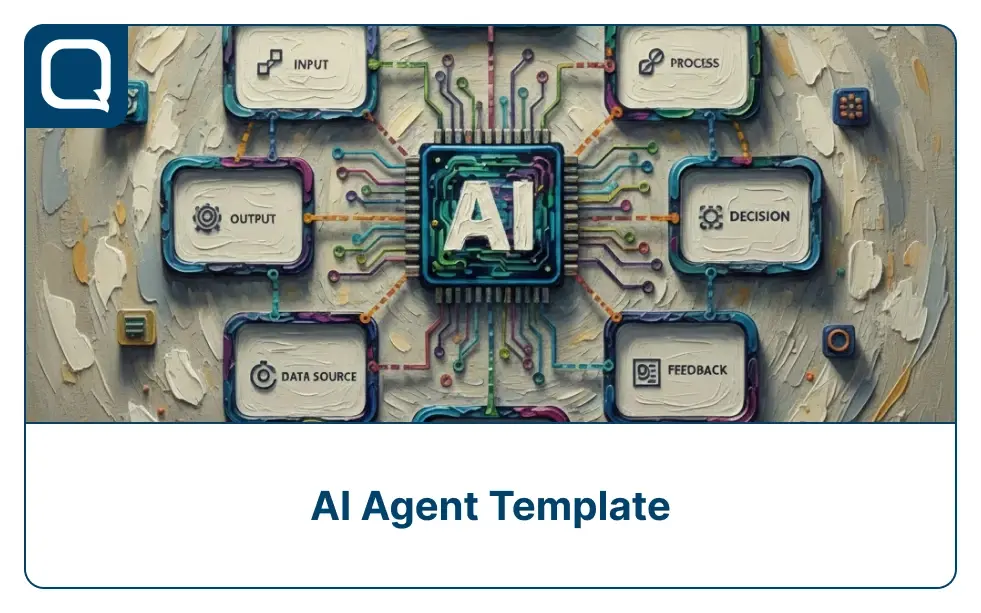
An AI Agent template is a ready-made blueprint for building AI-powered virtual agents, without starting from scratch.
Think of it as a digital playbook. Conversation structures, response logic, escalation paths, and baseline integrations are already defined. Your team only needs to customize the content and tone to match your brand voice.
With templates, teams no longer need to:
- Write prompts from zero
- Design conversation flows manually
- Build complex logic trees
Everything is modular, standardized, and reusable, covering customer service, sales qualification, and automated marketing interactions.
The result? Faster deployment, fewer errors, and teams that can focus on what truly matters: delivering fast, consistent, and high-value customer experiences.
This approach aligns with customer service operations best practices observed in real organizations in 2024–2025, including enterprises referenced by Gartner, and HBR where standardized workflows and playbooks are essential for scale.
Key Functions of AI Agent Templates in Customer Service Operations
AI Agent templates are operational accelerators across the entire customer journey. With a single standardized framework, businesses can streamline processes, improve SLA compliance, and deliver consistent service across channels.
1. Improving Customer Service Efficiency
Templates enable AI agents to handle repetitive inquiries automatically, reducing wait times and stabilizing response quality.
Human agents can then focus on complex, high-impact cases, mirroring the AI + human hybrid customer service model adopted by companies such as Amazon, Grab, and Shopee across the US and Southeast Asia.
Operational impact:
- Lower Average Handling Time (AHT)
- Higher First Contact Resolution (FCR)
- Improved SLA adherence
2. Accelerating Lead Qualification for Sales Teams
With predefined conversational logic, AI agents can qualify leads based on interest, budget, company size, or location.
Only high-intent leads are routed to sales teams, improving conversion rates and pipeline efficiency. This practice reflects CS Ops and RevOps alignment used by B2B SaaS across Singapore and Malaysia in 2024–2025.
3. Automating Marketing Engagement Across the Lifecycle
Templates can be adapted for personalized, behavior-based engagement:
- Campaign follow-ups
- Product recommendations
- Promotion reminders
These automated touchpoints support proactive customer service operations, a best practice widely discussed in CX reports and HBR customer experience studies.
4. Capturing Customer Data and Voice of Customer (VoC)
Every AI interaction generates structured insight. Templates can be configured to track:
- Response rates
- Sentiment trends
- Common complaint keywords
This data feeds into Voice of Customer (VoC) loops, enabling product, operations, and CX teams to continuously improve, an approach used by enterprises like Netflix and Airbnb.
How to Use AI Agent Templates Effectively
Building AI agents no longer takes weeks or specialized technical teams. With AI Agent templates, businesses can deploy in hours, select, customize, and launch.
1. Choose a Template Based on Business Objectives
Start by identifying your operational priority: customer support automation, lead qualification, or campaign engagement.
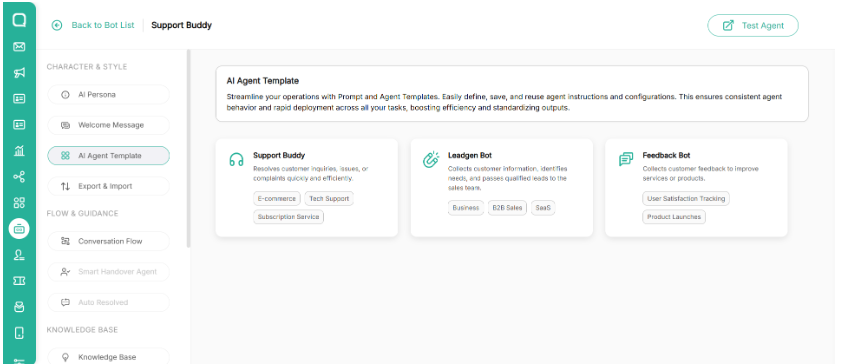
Qiscus AgentLabs provides templates such as:
- Customer Support Bot
- Sales Inquiry Bot
- Marketing Follow-Up Bot
These reflect customer service playbook structures used by real organizations across SEA in 2024–2025.
2. Customize Content and Conversation Flow
Templates allow teams to adjust prompts, responses, tone, and brand language. Built-in intents and entities ensure conversations remain natural and relevant.
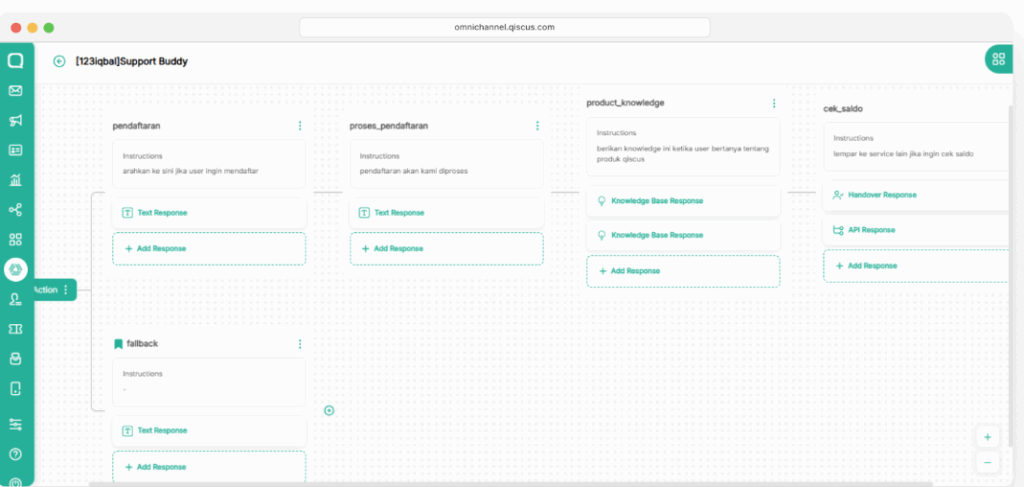
You can also define:
- Fallback responses
- Skill-based routing
- Escalation rules to human agents
This mirrors enterprise customer support best practices where AI assists but does not replace human judgment.
3. Integrate with Customer Interaction Channels
To deliver value, AI agents must operate where customers already are, WhatsApp, Instagram, websites, and marketplaces.
Through Qiscus Omnichannel Chat, all conversations are unified into one dashboard, preventing overlap and ensuring context continuity, an approach commonly adopted by telco and e-commerce leaders in the Philippines and Singapore.
4. Continuously Update the Knowledge Base
While templates provide a strong foundation, AI agents must be continuously trained to stay relevant. Customer questions, policies, products, and promotions evolve, and the AI agent needs to evolve with them.
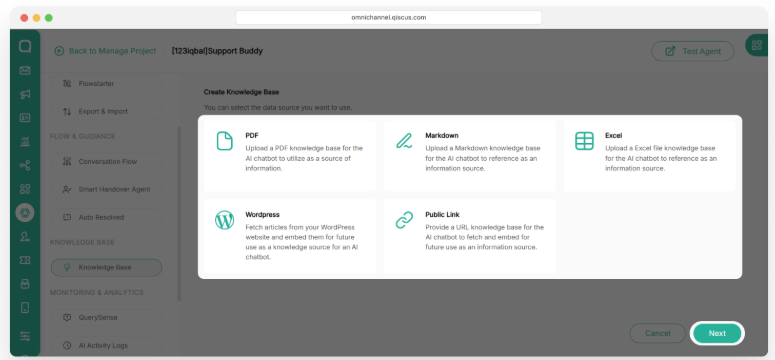
By regularly updating the knowledge base, businesses can train AI agents with the latest information, ensuring responses remain accurate and aligned with real customer needs. This ongoing update process is a critical part of AI agent training, allowing templates to stay effective as customer expectations and business operations change.
5. Test, Measure, and Optimize Performance
Once live, teams should test scenarios and monitor:
- Response time
- Completion rate
- Customer Satisfaction (CSAT)
Using Qiscus AgentLabs analytics, teams can iterate quickly, refining workflows, updating intents, and expanding the knowledge base as the business grows.
Types and Examples of AI Agent Template
Different businesses require different operational workflows. AI Agent templates provide structured conversation flows that can be deployed and customized quickly. Below are nine commonly used AI Agent templates in modern customer service, sales, and marketing teams, each with a conversation-based example.
1. FAQ Template
Used to handle high-volume, repetitive questions instantly and consistently.
Conversation example:
Customer: “Anong oras kayo bukas?”
AI Agent: “Bukas po kami mula 9:00 AM hanggang 9:00 PM araw-araw. May iba pa po ba kayong gustong itanong?”
2. Food & Beverage Business Template
Designed to support menu browsing, ordering, and promotions in chat-based commerce.
Conversation example:
Pelanggan: “Menu apa yang paling popular hari ini?”
AI Agent: “Menu paling laris hari ini ialah Nasi Ayam Teriyaki. Mahu terus buat pesanan atau lihat promosi kami?”
3. Customer Complaint Template
Structures complaint handling while maintaining empathy and operational control.
Conversation example:
Customer: “My order arrived damaged.”
AI Agent: “I’m sorry to hear that. Could you share your order number and a photo of the item so I can assist further?”
4. University Admission Template
Guides prospective students through complex and multi-step inquiries.
Conversation example:
Student: “What are the requirements to apply?”
AI Agent: “For undergraduate programs, you’ll need your academic transcript, ID, and English proficiency test results. Would you like guidance on the application steps?”
5. Offline Form Template
Captures customer data when live support is unavailable.
Conversation example:
Customer: “Is anyone available to help?”
AI Agent: “Our team is currently offline. May I collect your name, email, and inquiry so we can follow up shortly?”
6. Lead Generation Template
Qualifies prospects before passing them to the sales team.
Conversation example:
Customer: “I’m interested in your solution.”
AI Agent: “Sure. May I know your company size and the main challenge you’re trying to solve?”
7. Sales Conversion Template
Encourages immediate action through guided conversations.
Conversation example:
Customer: “Do you have any promotions?”
AI Agent: “Yes, we’re offering a 20% discount this week. Would you like to see the product catalog or proceed to purchase?”
8. Customer Marketing Template
Supports retention through personalized, lifecycle-based messages.
Conversation example:
AI Agent: “Hi Sarah, your subscription is due for renewal next week. Would you like to extend it now or explore an upgrade?”
9. NPS (Net Promoter Score) Template
Collects structured feedback after service interactions.
Conversation example:
AI Agent: “On a scale of 0–10, how likely are you to recommend us to a colleague?”
Customer: “8”
AI Agent: “Thank you. Could you share what we can improve to make your experience even better?”
Deliver Consistent Customer Experience Across Channels with AI Agent Template
In fast-moving markets, AI Agent templates are the most efficient way to ensure teams remain productive, responsive, and consistent across every interaction.
With Qiscus AgentLabs, businesses can deploy personalized AI agents in hours, not weeks. From answering FAQs and handling complaints to managing CSAT and SLA performance.
Don’t wait until customers leave due to slow service. Contact Qiscus today and discover how Qiscus can transform your teams!