The era of chatbots that only respond with “Press 1 for product information” is over. Modern businesses need systems that do more than reply to messages, they must understand context, recognize customers, and take action automatically.
This is where WhatsApp AI Agents come into play. They enable automation that understands customer intent, delivers relevant responses, and accelerates conversions across the customer journey.
Before diving into the step-by-step process, it’s important to understand what a WhatsApp AI Agent is and how it differs from conventional chatbots.
What Is a WhatsApp AI Agent?
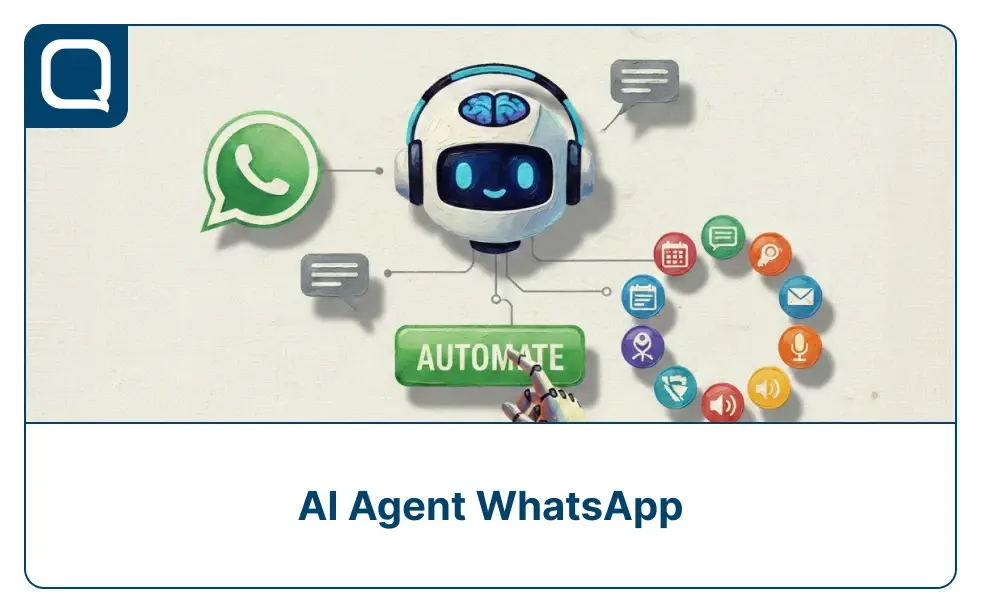
A WhatsApp AI Agent is the next evolution of conversational automation, designed to think, learn, and act like an intelligent virtual assistant within the WhatsApp Business API environment.
While traditional chatbots rely on scripted flows or keyword matching, AI Agents understand intent, conversation context, and even customer sentiment, enabling more natural and accurate responses.
For example, when a customer says, “My order hasn’t arrived, but the system says it was shipped,” a basic chatbot may respond with a generic tracking link.
An AI Agent, on the other hand, can analyze the conversation, retrieve order data via backend integration, and respond with: “Your order #8821 is currently in transit and scheduled to arrive tomorrow. We apologize for the delay.”
This is the core difference: AI Agents don’t just send automated replies, they act as an extension of your customer service team.
WhatsApp Chatbot vs. WhatsApp AI Agent
| Aspect | WhatsApp Chatbot | WhatsApp Agent |
| Response Capability | Script-based | Context- and intent-driven |
| Learning Ability | Static | Continuously learns from conversations |
| Data Integration | Limited | Connected to CRM, CDP, ERP, backend systems |
| Customer Experience | Rigid | Personalized, natural, and adaptive |
| Business Value | Handles basic FAQs | Improves efficiency, loyalty, and CX |
In practice, this means a WhatsApp AI Agent becomes a strategic layer in how businesses engage customers at scale. By combining conversational intelligence with real-time data access and clear escalation to human agents, AI Agents help teams respond faster, stay consistent, and resolve issues more effectively without losing the human touch.
For businesses using WhatsApp as a primary customer channel, adopting an AI Agent is no longer about automation alone. It is about delivering reliable, personalized experiences that meet modern customer expectations while keeping operations efficient and future-ready.
Why WhatsApp AI Agents Matter for Businesses
A WhatsApp AI Agent has become a foundational layer of modern customer experience strategy, especially in markets where messaging apps dominate customer communication.
Here are four key reasons why WhatsApp AI Agents are strategically important for businesses today.
1. Instant 24/7 Responses at Enterprise Scale
WhatsApp AI Agents provide immediate responses at any time, even outside business hours. Customers receive accurate answers without waiting for human agents to come online.
For example, large retail and logistics companies in the US and Europe began deploying AI agents between 2023–2024 to handle order inquiries during off-hours, reducing first response time by more than 40%.
In SEA, the impact is often amplified due to higher messaging volumes and stronger customer expectations for real-time replies. Enterprises in markets like Singapore, Malaysia, and the Philippines have adopted WhatsApp AI Agents to handle order tracking, delivery updates, and basic account inquiries during nights and weekends. Many report significant reductions in first response time and contact center workload, especially during peak campaigns and regional holidays.
The outcome is a smoother, more professional customer experience, without increasing operational costs.
2. Contextual and Personalized Conversations
Through CRM and customer data platform (CDP) integrations, WhatsApp AI Agents recognize who they’re speaking with and tailor responses accordingly.
In retail, global brands like Sephora and Nike have already implemented AI-driven conversational assistants that recommend products based on purchase history and browsing behavior. The task is simple:identify customer intent, but the outcome is significant: higher engagement and conversion rates.
Personalization shifts conversations from transactional to relational, increasing long-term loyalty.
3. Operational Efficiency Across Customer Support Teams
AI Agents can automate up to 70–80% of repetitive inquiries, such as order tracking, returns, account status, and product availability.
This pattern mirrors real-world deployments across enterprise customer support teams in telecommunications, SaaS, and financial services between 2024–2025, where AI Agents now handle tier-1 tickets. The outcome is lower Average Handle Time (AHT), reduced agent burnout, and better focus on high-value cases.
4. Consistency and Actionable Analytics
AI Agents ensure consistent responses across all conversations while capturing structured data from every interaction.
Enterprises in finance and insurance such as large US banks and global insurers across SEA, use AI Agents to analyze customer sentiment, identify recurring issues, and improve service workflows. These insights help leadership teams refine policies, reduce friction, and make data-driven decisions.
In this way, AI Agents become sources of operational intelligence.
Real-World AI Agent Use Cases Across Industries (2023–2025)
AI Agents are already deployed across multiple industries, delivering measurable outcomes through automation, integration, and human collaboration.
1. Customer Support (Enterprise & SaaS)
Global SaaS AI Agent companies, especially in SEA, began deploying AI Agents in 2023 to handle ticket intake, categorize issues, and route cases automatically.
Task: Classify tickets → route to correct team
Outcome: Lower resolution time and reduced support costs
Human handoff remains critical for complex or sensitive cases.
2. Retail & E-Commerce
Major retailers like Amazon and Walmart use AI-driven agents to manage order tracking, refunds, and product recommendations.
Task: Handle order inquiries → suggest alternatives
Outcome: Faster resolutions and improved conversion rates
3. Finance & Banking
Large financial institutions deploy AI Agents for balance inquiries, transaction explanations, and fraud alerts.
Task: Verify intent → retrieve account data
Outcome: Reduced call center volume and improved compliance through controlled automation
4. Healthcare
Healthcare providers and insurers use AI Agents for appointment scheduling, benefits explanations, and follow-ups.
Task: Schedule visits → send reminders
Outcome: Lower no-show rates and improved patient experience
Human escalation remains mandatory for medical decisions.
5. Logistics & Supply Chain
Global logistics companies use AI Agents to monitor shipment status and proactively notify customers.
Task: Track shipment → send real-time updates
Outcome: Fewer inbound inquiries and higher transparency
6. HR & Internal Operations
Enterprises deploy AI Agents internally to answer HR questions, manage leave requests, and onboard employees.
Task: Answer policy questions → automate requests
Outcome: Reduced HR workload and faster employee support
Across industries, the pattern is consistent: AI handles scale and speed, humans handle judgment and empathy.
How to Build a WhatsApp AI Agent
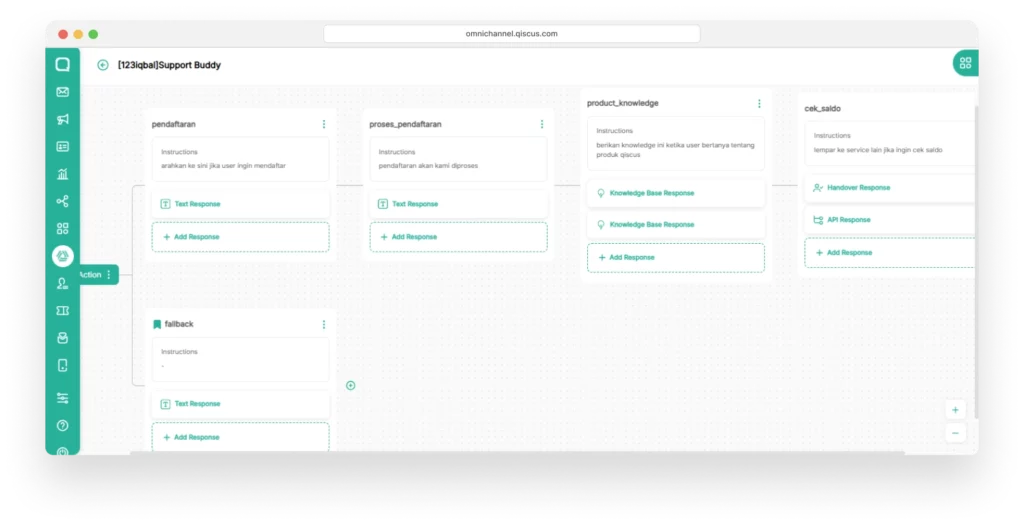
A WhatsApp AI Agent can be built using platforms like Qiscus AgentLabs, which integrates directly with the WhatsApp Business API. No coding is required, but strategic planning is essential.
1. Obtain WhatsApp Business API Access
The first step is registering through an official Business Solution Provider (BSP) such as Qiscus. Unlike the standard WhatsApp Business app, the API enables system integrations, automation, and AI-driven conversations.
This allows AI Agents to operate at scale, send real-time responses, and represent your brand with verified credibility.
2. Define Conversation Structure and Use Cases
Decide whether your AI Agent will focus on customer support, lead qualification, order tracking, or a combination. Each use case requires a different conversational approach.
With Qiscus AgentLabs, teams can design conversation flows using prompt templates or Dialogflow integration, ensuring consistent tone and brand alignment.
3. Integrate Backend Systems
Integration is what makes an AI Agent truly intelligent. Through Qiscus AgentLabs, AI Agents can connect to CRM systems, order databases, and omnichannel platforms.
This enables tasks such as checking order status, retrieving customer history, and delivering personalized recommendations, all within WhatsApp.
4. Enable NLP and Continuous Learning
Using NLP and large language models, AI Agents understand different phrasing styles and customer intents. Over time, continuous learning improves accuracy based on real conversations.
This approach mirrors how enterprise AI deployments evolved between 2024–2025, where ongoing training significantly improved resolution quality.
5. Implement Smart Human Handoff
A well-designed AI Agent knows when to escalate. With Smart Handover in Qiscus AgentLabs, conversations transfer seamlessly to human agents without losing context.
This hybrid model is a proven pattern in real-world enterprise deployments.
6. Monitor, Analyze, and Optimize
Once live, teams should regularly analyze metrics such as response time, resolution rate, CSAT, and sentiment trends.
These insights guide optimization efforts, ensuring the AI Agent continues to evolve alongside customer expectations.
A New Era of Customer Interaction Starts with WhatsApp AI Agents
Customer interaction is about understanding intent, context, and emotion. Unlike traditional chatbots, WhatsApp AI Agents deliver instant responses, recognize customers, and take intelligent action within a single conversation.
On one of the most widely used messaging platforms in the world, WhatsApp AI Agents bridge efficiency and empathy. Every message becomes an opportunity to build trust, loyalty, and long-term value.
Start building the future of customer interaction on WhatsApp with AI Agents powered by Qiscus, and deliver experiences that are faster, smarter, and truly human-centric. Give us a call today!