People expect brands to reply on Facebook, Instagram, TikTok, and even WhatsApp and they expect replies fast. With thousands of comments, DMs, and mentions happening in real time, businesses can’t rely on manual monitoring anymore.
That’s where social media customer service software becomes essential. These platforms help teams manage conversations, track response time, automate replies, boost team productivity, and ultimately protect brand reputation.
This guide breaks down 10 of the best tools, how they work, and why they matter.
What Is Social Media Customer Service Software?
Social media customer service software is a platform that helps businesses manage customer interactions across social channels, such as Facebook comments, Instagram DMs, TikTok messages, Twitter/X mentions, and others, from a single dashboard.
Instead of teams switching between apps, everything is centralized, organized, and trackable. For brands dealing with high volume, this becomes a game-changer.
Why Businesses Need It
In Malaysia and across Southeast Asia, social media has become the first stop for customers, whether they want to ask questions, request support, compare brands, leave feedback, or even voice complaints publicly.
Here’s why a dedicated social media customer service tool matters for modern businesses:
1. Customers Expect Instant Responses
Social media is built for real-time interaction. Customers interpret slow replies as poor service or lack of interest. Fast responses signal reliability and professionalism, increasing trust from the first touchpoint.
2. High Volume Makes Manual Monitoring Impossible
Comments, DMs, and mentions come from multiple platforms at once. Manual tracking quickly leads to missed messages and delayed follow-ups. A centralized system ensures every conversation is captured and handled properly.
3. Public Conversations Affect Brand Reputation
Social replies are visible to everyone, not just the customer. One unresolved thread can shape public perception of your brand. Consistent and timely responses demonstrate accountability and care.
4. Social Media Drives Purchase Decisions
Many Malaysians and other SEA countries check comment sections before buying. They observe how brands respond to questions and complaints. Responsive support builds confidence and directly influences buying decisions.
5. Unresolved Issues Can Go Viral
Negative experiences spread faster than positive ones. When complaints are ignored, customers often escalate publicly. Quick intervention helps control the narrative before it escalates.
6. Faster Response Time = Higher Customer Satisfaction
Speed remains one of the top drivers of customer satisfaction. Social service tools help teams manage SLAs and prioritize urgent cases. This creates smoother experiences and reduces frustration.
7. Teams Work More Efficiently
Without the right tools, agents repeat the same tasks and responses. Automation and smart routing reduce manual effort. Teams can handle higher volumes without sacrificing quality.
8. It Ensures Omnichannel Consistency
Customers move freely between platforms during their journey. A unified system keeps conversation history and tone consistent. This prevents repeated questions and improves overall experience.
9. Data Helps Improve Strategy
Social interactions generate valuable customer insights. Analytics reveal patterns in sentiment, response time, and common issues. These insights help brands improve messaging, products, and service strategies.
10. It Directly Impacts Sales and Retention
Customer service no longer supports sales, it influences it. Timely assistance removes buying friction and builds loyalty. Over time, this increases retention and lifetime customer value.
With customer behaviour becoming increasingly mobile-first and social-first, expectations for fast and accurate responses are higher than ever. This is why businesses need tools that can keep up with the rapid pace of digital conversations and ensure every interaction is handled promptly and professionally.
10 Best Social Media Customer Service Software Guide
Below are the top 10 platforms, selected based on features, relevance to SEA markets, and suitability for growing businesses.
1. Qiscus Omnichannel Chat
Qiscus stands out as one of the most complete customer service platforms for Malaysia and Southeast Asia. It centralizes Facebook comments, Instagram DMs, TikTok messages, WhatsApp, Web Chat, Email, and more into one unified dashboard.
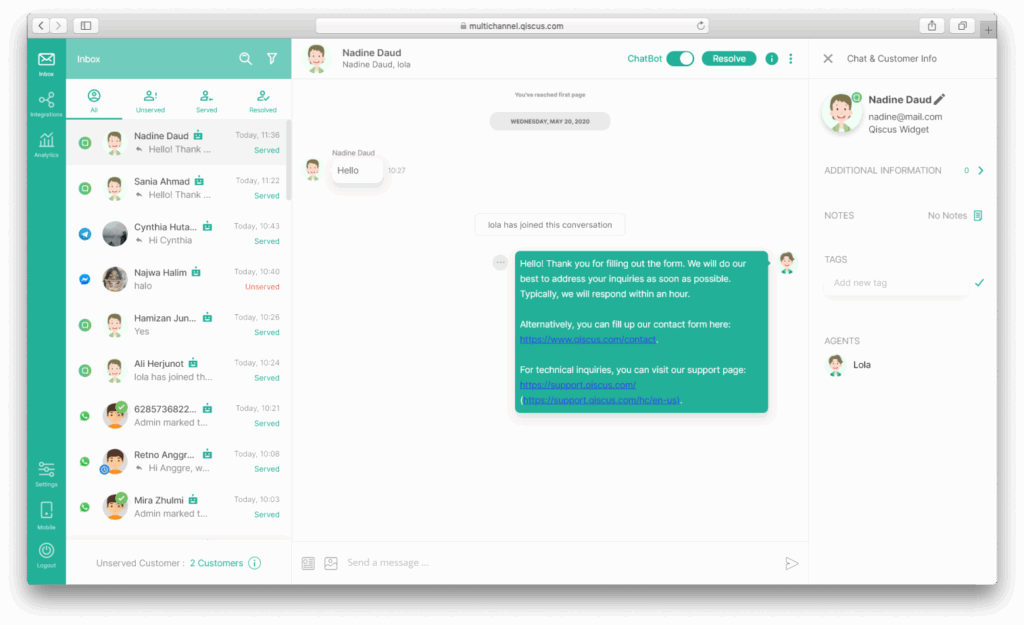
What makes Qiscus stand out:
- AI Agent (AgentLabs) – Unlike any software on this list, Qiscus includes AI agents capable of handling repetitive inquiries, and assisting with classification and routing.
- Agent Copilot – An AI assistant that recommends clear, context-based replies in real time so agents can respond faster, stay consistent, and maintain high-quality service.
- Unified Social Inbox – Manage social media comments, posts, and DMs without switching apps.
- Hyper-fast customer service – Automations, canned responses, and routing reduce waiting time dramatically.
- Industry-grade reliability – Widely adopted across Malaysia, Indonesia, and SEA enterprises.
- Analytics dashboard – Track speed, ticket volume, agent performance, and customer satisfaction.
Who is Qiscus for?
Businesses want a reliable, scalable, AI-driven social customer service solution, especially those managing high conversation volume across multiple channels.
Qiscus Successes
Sales Development Representative (SDR) teams in Qiscus use Qiscus AgentLabs to handle inbound leads coming from social media and messaging channels. With this setup, up to 50% of lead qualification requirements are handled by AI, allowing SDRs to focus on high-intent prospects. As a result, response time improves, lead quality becomes more consistent, and sales teams can engage prospects at the right moment without increasing headcount.
Meanwhile, Bank Raya leverages Qiscus Omnichannel to overcome customer service bottlenecks caused by high interaction volumes. By centralizing conversations and automating workflows, Bank Raya achieved an Average Resolution Time improvement of up to 97.6%, while consistently maintaining a CSAT score of 4.5/5 through regular customer surveys. This enables their service teams to deliver faster, more reliable support without compromising customer satisfaction.
2. Zendesk
Zendesk is globally recognized for customer service, especially for large companies. Its social media capabilities come through integrations like Facebook Messaging and WhatsApp.
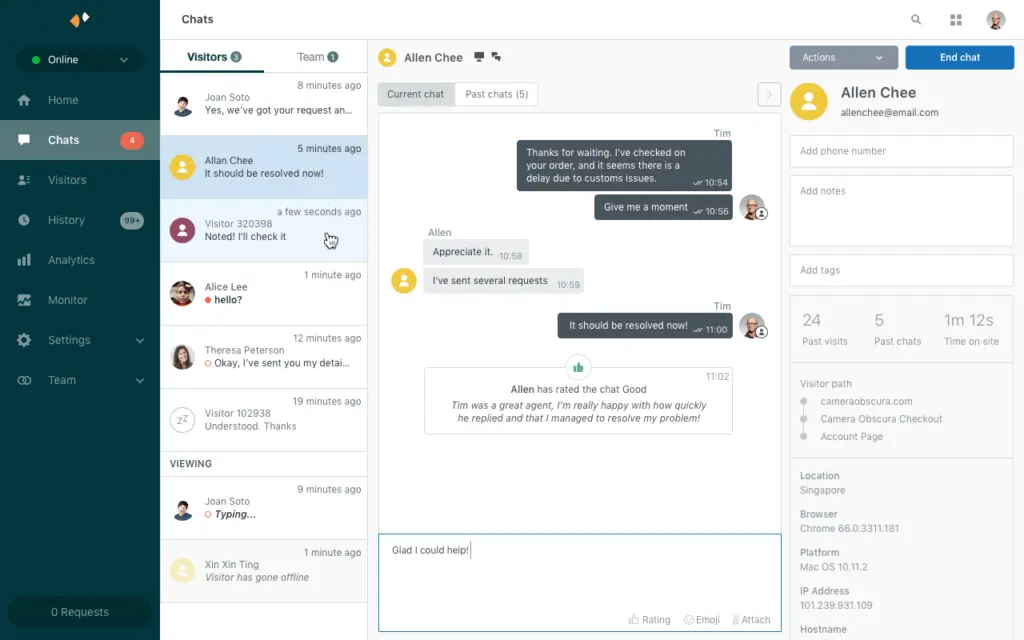
Why people choose Zendesk
- Strong ticketing and automation
- Suitable for complex workflows
- Good reporting and satisfaction tools
Limitations
- Social media comment management is basic
- AI functions require add-ons
- Not built specifically for SEA markets
- Expensive for SMEs
3. SleekFlow
Popular in Malaysia, SleekFlow combines social messaging with commerce capabilities like payment links and order tracking.
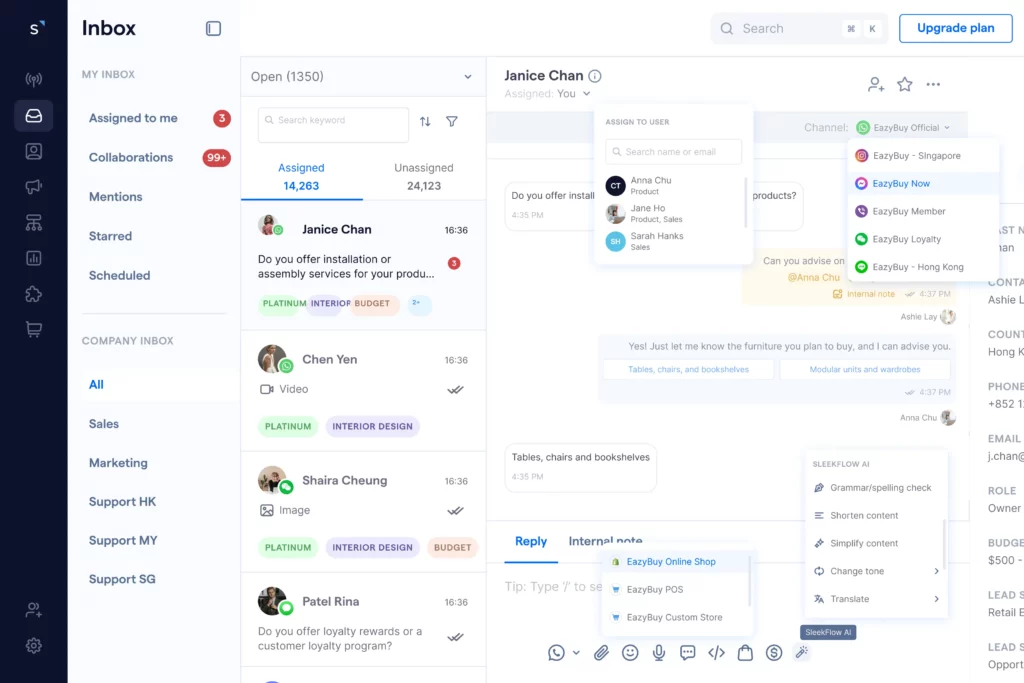
Strengths
- Great for Instagram and WhatsApp commerce
- Good automation templates
- Easy-to-use interface
Limitations
- Not optimized for deep customer service workflows
- Lacks full AI agent capabilities
- Reporting features are simpler compared to enterprise tools
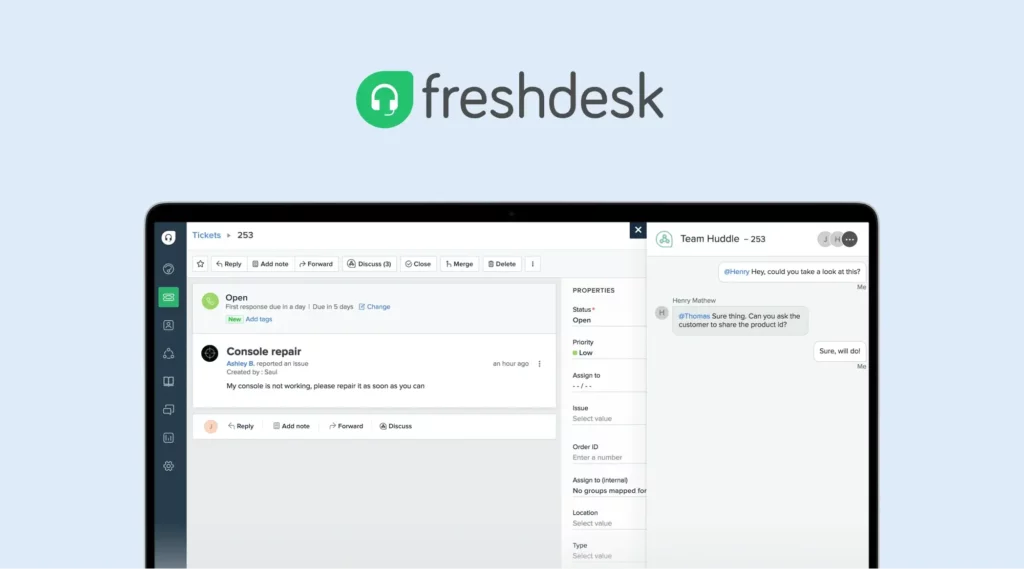
4. Freshdesk / Freshchat
Freshdesk is known for its ticketing-first approach. With Freshchat, brands can manage conversations across multiple social channels.
Pros
- Good automation rules
- Suitable for global/onshore teams
- Provides chatbot builder
Cons
- Social media coverage is not as comprehensive
- AI is limited unless using Freshbots add-on
- Integration setup can be technical
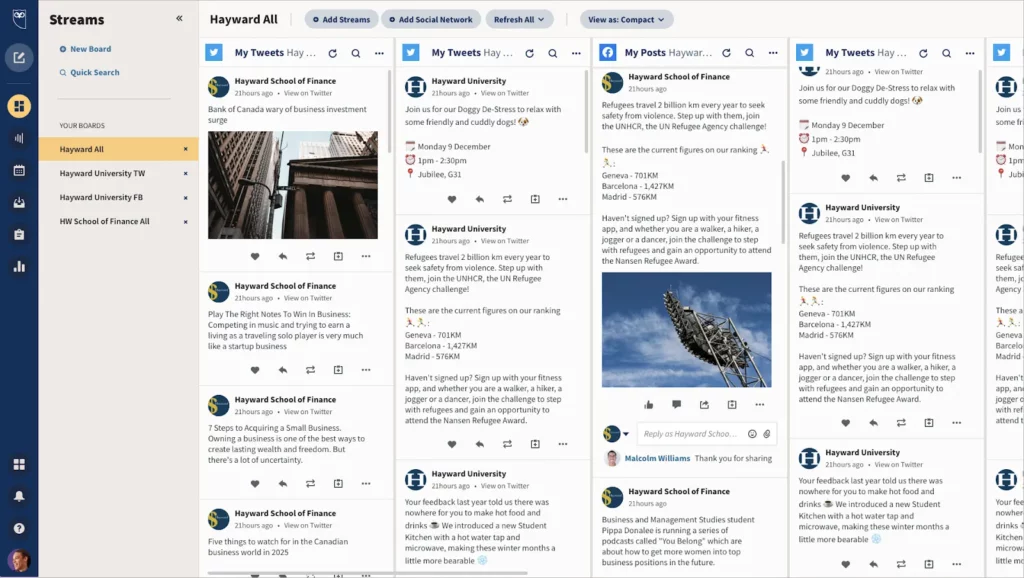
5. Hootsuite
Hootsuite is widely used for social media management, scheduling social media posts, tracking engagement, and monitoring trends.
Pros
- Strong analytics
- Great for content teams
- Helps monitor brand mentions
Cons
- Not designed for customer service
- No unified inbox for DMs
- No AI response engine
- Not suitable for high-volume support teams
6. Sprinklr
Sprinklr is a top-tier platform designed for large corporations, telecoms, and global enterprises.
What it does well
- Predictive AI
- Advanced listening tools
- Global compliance and security
Drawbacks
- Very expensive
- Overkill for SMEs
- Requires long onboarding and training
7. Respond.io
Respond.io focuses heavily on messaging channels and is widely used for WhatsApp-driven support.

Strengths
- Good automation
- Supports many connectors
- Simple to deploy
Limitations
- Social media comment management is limited
- No AI agent capability
- Reporting is not as deep for service teams
8. Zoho Desk
Zoho Desk offers several communication channels with integrations into the larger Zoho ecosystem.

Good for:
- Small/medium businesses
- Teams using Zoho CRM or Zoho Books
Limitations
- Social media tools require add-ons
- Automation is basic
- Interface can feel outdated
9. LiveAgent
LiveAgent supports email, live chat, and social channels with a focus on mid-sized teams.

Pros
- Easy to use
- Affordable
- Good ticketing features
Cons
- Limited SEA market relevance
- No AI capabilities
- Not optimized for fast-moving social platforms
10. NapoleonCat
NapoleonCat provides tools for moderating comments, tracking engagement, and publishing content.

Strengths
- Good for Facebook & Instagram responses
- Helps track social analytics
- Useful for marketing teams
Weaknesses
- Not a full customer service solution
- No AI or automation engine
- No WhatsApp integration
Choosing the right social media customer service platform depends on your team size, customer volume, and the level of automation you need. While each tool offers unique strengths, businesses in Malaysia and Southeast Asia should prioritise platforms that can keep up with fast-moving, mobile-first customer behaviour.
With the right software, brands can respond faster, manage conversations more efficiently, and deliver the kind of seamless support that builds trust and long-term loyalty across every digital channel.
How and When to Choose the Right Platform
Before choosing any platform, it’s important to understand whether your business actually needs a social media customer service tool, and why. As customer interactions increasingly happen in public and in real time, relying on manual monitoring quickly becomes unsustainable.
Use the points below to analyze your business needs first. Once you see which challenges apply to you, the next step is finding a tool that truly fits those needs.
1. Volume of Daily Comments & Messages
High message volume increases the risk of slow responses and missed conversations. Automation and AI help categorize, prioritize, and handle repetitive inquiries instantly. This allows agents to focus on complex issues while maintaining consistent service quality.
2. Number of Agents
Larger teams require clear visibility and structured workflows. Advanced routing prevents ticket overlap and reduces internal handoffs. With real-time analytics, managers can spot bottlenecks and optimize team performance faster.
3. Channels Your Customers Use
Customers rarely stick to just one channel. In Malaysia and across SEA, WhatsApp dominates, but Instagram and Facebook are close behind. A platform with native omnichannel support ensures conversation history stays unified, even when customers switch channels.
4. Your Growth Stage
Early-stage businesses prioritize speed and affordability. As companies scale, needs shift toward integrations, automation, and governance. Choosing a scalable platform early helps avoid costly migrations later.
5. Budget
The cheapest tool isn’t always the most cost-efficient. Higher-priced platforms may offer stronger reliability and support, while lower-cost options can create hidden operational costs. Evaluating ROI based on productivity gains and customer satisfaction leads to better decisions.
6. Client Testimonials & After-Sales Service
Real customer stories reveal how a platform performs beyond sales promises. Testimonials highlight reliability, support quality, and long-term value in real-world use. Strong after-sales service ensures smooth onboarding, faster issue resolution, and continuous support as your needs evolve.
Once these challenges start appearing, the focus shouldn’t be on choosing the most popular platform, but on finding one that aligns with your actual operational needs.
This is also why Qiscus stands out, it checks every one of these points. Designed to handle high interaction volume, multi-agent teams, and omnichannel conversations, Qiscus helps businesses move from reactive social media handling to structured, scalable customer engagement, whether you’re a growing SME or a large enterprise.
With the right analysis and the right platform, social media customer service becomes not just manageable, but a competitive advantage.
Social Media Customer Service Defines Brand Trust
In Southeast Asia, customers judge brands based on how fast and how well they respond online. A missed comment or ignored DM can quickly become a lost customer. The right tool helps you stay consistent, efficient, and scalable across all social channels.
If you want an all-in-one platform that handles Instagram, Facebook, TikTok, WhatsApp, and adding AI capabilities to your workflow, Qiscus remains the most complete choice for SEA businesses. Want to try and see it yourself? Give us a call today!