Across the US and Southeast Asia (SEA), large enterprises are dealing with rising ticket volumes, fragmented communication channels, stricter compliance requirements, and customers who expect instant, personalized responses.
If your business is operating across multiple countries, handling millions of users, or navigating regulated industries, choosing the wrong platform is risky.
This guide breaks down the best enterprise customer service platforms used by large companies, with a focus on capabilities, scalability, security, and regional relevance (especially in Malaysia, the Philippines, and Singapore).
Enterprise Customer Service is Getting More Complex
Customer service at the enterprise level operates under a fundamentally different set of pressures. As organizations scale across regions, product lines, and regulatory environments, support operations become significantly more intricate. What once worked for mid-sized teams quickly breaks down when volume, compliance, and integration demands increase simultaneously.
1. Omnichannel Communication at Scale
Large companies manage interactions across email, live chat, WhatsApp, voice, and social media simultaneously. Each channel has different response expectations and operational workflows. Without centralization, agents switch between disconnected tools, increasing response time and error risk.
2. High Ticket Volume Across Regions
Enterprise organizations often support customers across multiple countries and time zones. This creates constant ticket inflow, varying peak hours, and language diversity. Multilingual support and regional nuance become operational requirements rather than optional capabilities.
In Southeast Asia, cultural expectations around tone and responsiveness further increase service complexity.
3. Regulatory and Compliance Requirements
Large enterprises operate under strict regulatory frameworks such as SOC 2, HIPAA, PCI DSS, and regional regulations like PDPA in Singapore. Compliance is not limited to backend systems, it extends to how customer data is accessed, stored, and transmitted within support workflows.
Failure to align service operations with compliance standards can lead to financial penalties and reputational damage.
4. Deep Integration With Internal Systems
Enterprise support teams must connect their help desk platform with CRM systems, ERP platforms, payment gateways, and internal databases. Without integration, agents lack context, leading to repetitive questioning, slower resolution, and fragmented customer journeys.
In the US, many Fortune 500 companies rely on enterprise-grade platforms that combine AI-powered routing, advanced workflow automation, and deep CRM integration to manage this complexity effectively.
5. 24/7 Service Expectations
Global operations demand round-the-clock availability. Customers expect immediate acknowledgment, even outside traditional business hours. Automation, intelligent routing, and distributed teams become essential to meeting SLA commitments consistently.
Without proper infrastructure, enterprises struggle to maintain both speed and quality at scale.
6. The Cost of Fragmented Systems
Without a unified enterprise help desk platform, teams frequently switch between tools, duplicate work, and miss SLA targets. Disconnected systems create inconsistent customer experiences and inflate operational costs through inefficiencies and rework.
Enterprise customer service complexity will only increase as digital channels expand and compliance standards evolve. The solution is consolidating intelligently. A unified enterprise platform that integrates channels, automates workflows, ensures compliance, and supports multilingual engagement becomes a strategic necessity.
In high-growth markets across the US and Southeast Asia, enterprises that centralize their support infrastructure will be better positioned to scale efficiently, without compromising customer experience.
When Enterprise Customer Service Systems Don’t Scale
In enterprise environments, system limitations are not just operational inconveniences, they are strategic risks. In regulated industries such as banking, healthcare, and telecommunications, service breakdowns can lead to compliance violations, financial penalties, and long-term reputational damage.
When infrastructure cannot scale with demand or regulatory complexity, customer trust weakens quickly.
Consider these scenarios:
- A Singapore-based digital bank handling cross-border payments must securely log every customer interaction and comply with MAS regulations. Any gap in audit trails, data protection, or message archiving could trigger regulatory scrutiny and erode institutional credibility.
- A US healthcare provider must ensure HIPAA-compliant communication across email, chat, and voice. If sensitive patient data flows through unsecured channels or fragmented systems, the organization risks legal exposure and loss of patient confidence.
- A Philippine telco managing outage complaints during peak hours must absorb sudden spikes in volume without system crashes or long queue times. When platforms fail under pressure, frustration escalates publicly, especially on social media.
When enterprise customer service software lacks key capabilities, operational cracks appear:
1. AI-powered Triaging
Without intelligent categorization and routing, tickets pile up in the wrong queues, increasing resolution times and overwhelming agents during high-volume periods.
2. Secure Data Storage
Inadequate encryption, weak access controls, or incomplete audit logs expose organizations to regulatory penalties and data breach risks.
3. Omnichannel unification
Disconnected systems force customers to repeat information and prevent agents from seeing full context, reducing efficiency and increasing dissatisfaction.
4. Enterprise-grade Uptime
Downtime during peak demand can halt operations entirely. For critical industries, even brief outages can damage reliability perceptions.
Enterprise customer support software must do more than track cases. It must orchestrate end-to-end customer journeys, securely, intelligently, and at scale.
When systems are resilient, compliant, and unified, they protect more than workflows. They protect brand trust, regulatory standing, and long-term customer loyalty.
13 Best Enterprise Customer Service Platforms for Businesses
As enterprise customer expectations rise, customer service platforms must go beyond ticket management. Today’s leading solutions combine AI, omnichannel orchestration, compliance readiness, and deep system integration to support complex operations across industries such as banking, healthcare, telecom, and retail.
Below is a curated list of enterprise-grade customer service platforms used globally with a strong focus on scalability, automation, and regulatory support.
1. Qiscus Omnichannel Customer Service Platform
Built specifically for the messaging-first ecosystem, Qiscus delivers enterprise-grade capabilities while addressing regional communication realities.
Used by: Large enterprises in Indonesia, Malaysia, Singapore, and the Philippines, especially in banking, fintech, telecom, and retail.
Enterprise capabilities:
- Native omnichannel support (WhatsApp, Instagram, Facebook Messenger, email, live chat, voice)
- AI-powered routing and chatbot automation
- Unified agent dashboard across channels
- CRM and core system integration
- Enterprise-grade security and compliance readiness
- Scalable infrastructure for high concurrent conversations
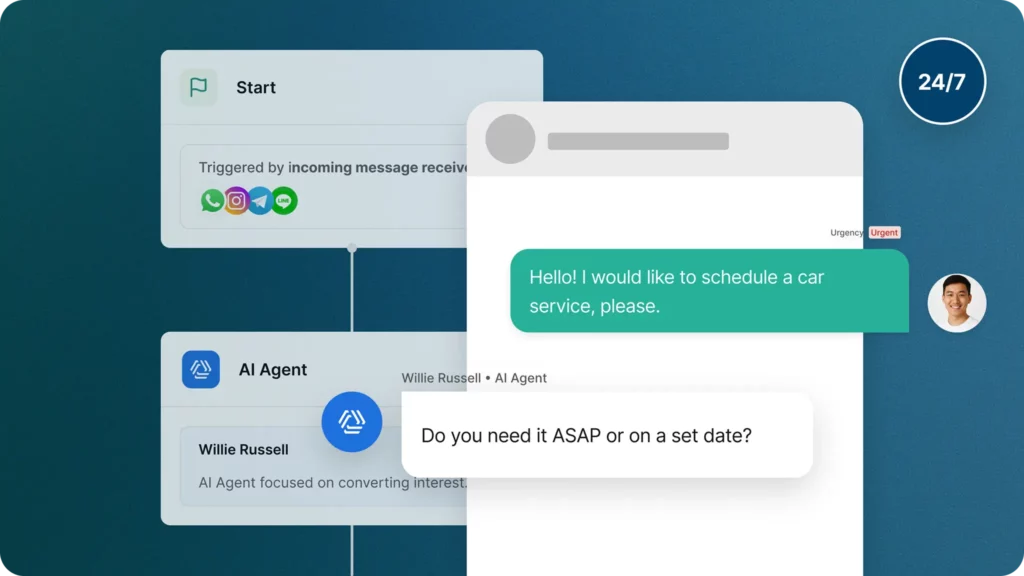
Unlike many global platforms optimized for email or ticket-centric workflows, Qiscus is designed around real-time messaging behavior. It supports multilingual operations, high WhatsApp adoption, digital banking growth, and social-driven escalation patterns common in Southeast Asia.
For enterprises across the world, Qiscus combines enterprise automation with regional precision, making it not only scalable, but contextually aligned.
2. Salesforce Service Cloud

One of the most widely adopted enterprise customer service platforms among Fortune 500 companies.
Used by: Global banks, healthcare organizations, retail enterprises
Key capabilities:
- Omnichannel support (chat, email, voice, social)
- AI-powered routing (Einstein AI)
- Deep CRM integration
- Enterprise workflow automation
- SOC 2 and HIPAA support
Strong choice for enterprises already embedded in the Salesforce ecosystem.
3. Zendesk
A leading enterprise help desk platform used globally.
Used by: Large e-commerce brands, SaaS enterprises, technology companies
Strengths:
- Advanced ticketing and automation
- AI-powered agent assist
- Enterprise analytics
- Marketplace integrations
Popular among Singapore regional headquarters managing APAC support.
4. Genesys Cloud CX

Strong in voice-heavy and contact-center-centric industries.
Used by: Airlines, telecom providers, financial institutions
Capabilities:
- Advanced voice infrastructure
- Journey orchestration
- Workforce engagement management
- AI-driven routing
5. ServiceNow Customer Service Management

Designed for enterprises requiring tight IT and service alignment.
Used by: Global enterprises, regulated industries
Strengths:
- Workflow automation
- Enterprise system integration
- ITSM alignment
- Governance and compliance support
6. Microsoft Dynamics 365 Customer Service

Deeply integrated within the Microsoft enterprise ecosystem.
Used by: Government agencies, B2B enterprises
Capabilities:
- Omnichannel engagement
- AI Copilot
- Integration with Microsoft 365 and Azure
7. Freshworks Freshdesk Enterprise
Well-adopted across Southeast Asia and growing globally.
Used by: Regional enterprises in Malaysia and the Philippines, as well as global mid-to-large companies
Strengths:
- Omnichannel support
- AI-based ticket routing
- Enterprise reporting
- Cost-effective scalability
8. HubSpot Service Hub Enterprise

Integrated CRM and service platform.
Used by: Scaling tech enterprises and B2B organizations
Strengths:
- CRM and service unification
- Knowledge base automation
- Enterprise dashboards
9. Oracle Service

Enterprise-grade solution for global organizations.
Used by: Telecommunications companies, multinational enterprises
Capabilities:
- Advanced workflow automation
- AI-powered digital assistant
- ERP integration
- Enterprise scalability
10. SAP Service Cloud

Part of SAP’s enterprise ecosystem.
Used by: Manufacturing, utilities, global B2B enterprises
Capabilities:
- ERP integration
- Field service management
- Enterprise-grade compliance
11. Talkdesk
Enterprise cloud contact center platform.
Used by: Financial services, healthcare, service providers
Capabilities:
- AI voice automation
- Workforce management
- Compliance support
- Omnichannel routing
12. Five9
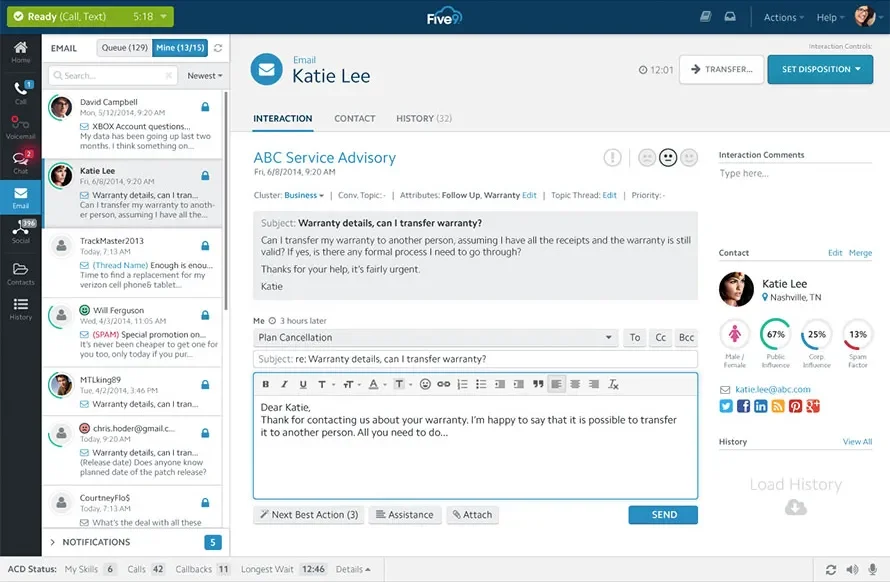
Cloud-based enterprise contact center solution.
Used by: Finance, telecom, retail enterprises
Capabilities:
- Intelligent virtual agents
- Omnichannel routing
- Enterprise scalability
13. NICE CXone

Global enterprise CX platform.
Used by: Fortune 500 companies and regulated industries
Capabilities:
- Omnichannel routing
- AI analytics
- Workforce optimization
- Compliance controls
Selecting an enterprise customer service platform depends on infrastructure alignment, regulatory requirements, and customer behavior patterns.
Global platforms offer deep ecosystem integration and large-scale automation. However, for enterprises operating in Southeast Asia’s messaging-dominant markets, contextual alignment is equally critical.
Platforms like Qiscus stand out by combining enterprise-grade scalability with regional messaging expertise, ensuring automation enhances, rather than replaces, human-centered engagement.
How to Evaluate an Enterprise Customer Service Platform
Selecting customer service software for large enterprises in 2025 requires more than comparing feature lists. Organizations must assess whether a platform can support operational complexity, regulatory demands, and evolving customer expectations, without sacrificing performance or visibility.
A structured evaluation helps decision-makers avoid costly migrations and ensure long-term scalability.
1. Omnichannel Depth
True omnichannel support goes beyond simply offering multiple channels. The platform should unify email, live chat, voice, and social messaging into a single customer timeline.
Agents must see full conversation history across channels in one view. Without this continuity, customers are forced to repeat themselves, reducing efficiency and satisfaction.
2. Workflow Automation
Enterprise environments require automation at scale. The system should support automatic ticket categorization, intelligent routing, escalation logic, and SLA tracking.
Well-designed workflows reduce manual errors, ensure accountability, and maintain service consistency, especially during high-volume periods.
3. AI Capabilities
Not all AI is equal. Evaluate whether the platform provides meaningful agent assistance, such as suggested replies, sentiment analysis, context summarization, and predictive routing—not just standalone chatbots.
AI should enhance human performance and decision-making, not simply deflect tickets.
4. Integration Flexibility
Large organizations operate complex tech stacks. The platform must integrate seamlessly with CRM systems, ERP solutions, core banking platforms, data warehouses, and internal dashboards.
Open APIs and flexible architecture are critical to prevent data silos and ensure real-time synchronization across departments.
5. Scalability
Seasonal spikes, promotional campaigns, and crisis events can dramatically increase ticket volumes. The platform should maintain performance under high concurrency without latency or downtime.
Scalability ensures operational stability as the organization grows.
6. Security & Compliance
Enterprises must comply with industry regulations and regional data protection laws. Evaluate whether the platform supports enterprise-grade security standards, audit trails, role-based access control, and relevant certifications.
Strong governance capabilities reduce legal risk and protect customer trust.
Choosing an enterprise customer service platform is a long-term strategic investment. Beyond features, organizations should evaluate reliability, ecosystem compatibility, and future-readiness.
A platform that balances omnichannel depth, automation, AI support, integration flexibility, scalability, and compliance will improve operational efficiency and strengthen customer experience at scale.
Qiscus Capabilities Built for Enterprise-Ready
For enterprise companies in Southeast Asia, choosing a customer service platform isn’t just about global reputation, it’s about regional fit. Qiscus designs its solutions around how customers in SEA actually communicate: messaging-first, high-volume, and fast-moving.
Below are the core enterprise capabilities delivered through Qiscus products.
1. Omnichannel Messaging
Qiscus Omnichannel centralizes WhatsApp, Instagram, Facebook Messenger, email, live chat, and voice into a single unified dashboard.
This enables enterprise teams to:
- Eliminate channel silos
- Maintain a full customer conversation timeline
- Monitor SLA performance in real time
- Manage high concurrent messaging volumes efficiently
For enterprises in SEA and across the world, Qiscus ensures conversations stay organized and scalable.
2. AI Agent & Automation
Qiscus AgentLabs automates repetitive inquiries and first-level support while maintaining conversational context.
With this solution, enterprises can:
- Provide 24/7 automated responses
- Deflect common FAQs before reaching agents
- Qualify leads or service requests automatically
- Reduce operational costs during peak periods
For fintech and e-commerce enterprises across SEA, Qiscus helps scale support operations without proportionally increasing headcount.
3. Qiscus AI Routing & Agent Assist
Through intelligent routing and automation, Qiscus distributes conversations based on skill set, language, priority, or customer segmentation.
Key capabilities include:
- Real-time workload balancing
- Multilingual routing for diverse SEA markets
- Suggested replies and contextual agent assistance
- SLA-based escalation workflows
This is especially valuable for Singapore-based enterprises serving multilingual customer bases.
4. Qiscus Enterprise Integration Framework
Qiscus integrates seamlessly with CRM systems, core banking platforms, ERP tools, and internal enterprise dashboards.
This allows enterprises to:
- Access 360-degree customer data within one interface
- Trigger automated workflows across departments
- Synchronize customer records in real time
- Strengthen compliance documentation and audit readiness
For regulated industries such as digital banking and telecom, Qiscus reduces manual risk and improves operational visibility.
5. Qiscus Security & Compliance Architecture
Enterprise customers require infrastructure that meets strict governance standards. Qiscus is built with enterprise-grade security practices, including:
- Role-based access controls
- Secure data management
- Conversation logging and archiving
- Structured audit trails
For enterprises operating under PDPA in Singapore and Malaysia, this ensures regulatory alignment without sacrificing agility.
6. Qiscus High-Concurrency Infrastructure
Qiscus is engineered to handle large volumes of simultaneous conversations—especially during flash sales, product launches, or service disruptions.
This ensures:
- Stable performance during traffic spikes
- Distributed load handling
- Real-time operational dashboards for management visibility
In social-sensitive markets where service issues escalate quickly online, Qiscus helps enterprises maintain responsiveness and protect brand trust.
Build Your Enterprise Level Customer Service with Qiscus
In 2025, enterprise customer service platforms are strategic infrastructure. While US enterprises often prioritize AI and compliance, and Southeast Asian companies focus on omnichannel scalability and rapid digital growth, the core need remains the same: secure, automated, and human-centered systems that scale reliably. At enterprise level, every interaction impacts trust, and every failure scales.
Explore how Qiscus can support your enterprise growth, schedule a demo today and see how messaging-first automation meets enterprise-grade performance.