The integration of AI Agents into customer service is no longer just about efficiency. It represents a fundamental restructuring of how service teams operate. As businesses face growing pressure to deliver customer experiences that are both highly personalized and infinitely scalable, a critical question emerges: how can humans and machines collaborate within a single system that strengthens both?
The role of the human agent in AI-driven environments has shifted dramatically. AI Agents are no longer simple tools to speed up response times; they are catalysts for organizational transformation, reshaping how service teams are structured, how decisions are made, and how customer value is created.
As a result, customer service leaders and business owners face a new challenge on how to redesign collaboration between human agents and AI agents to deliver long-term impact for both customers and the business.
The future customer service team is no longer divided between humans and AI. Instead, it is unified by shared data, integrated systems, and aligned goals, working together to deliver superior customer experiences.
When Humans and AI Work Together
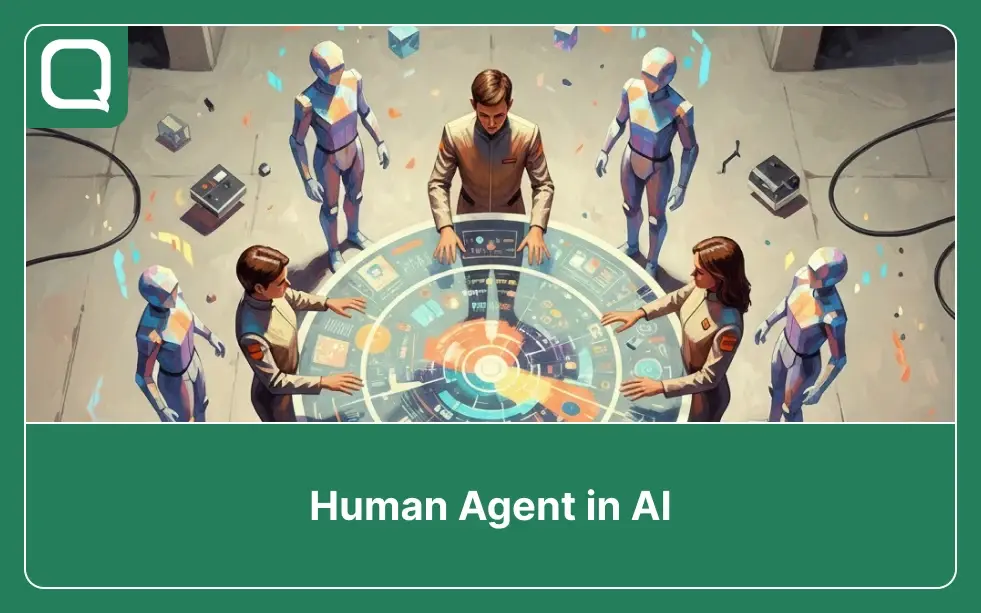
Traditional customer service organizations were built on linear hierarchies: supervisors at the top, agents below them, and customers at the end of the communication chain. With the rise of enterprise AI agents and automation platforms, this model is evolving into a dynamic, collaborative intelligence network.
AI agents now handle repetitive and mechanical tasks such as answering frequently asked questions, categorizing incoming messages, routing cases, and identifying behavioral patterns across customer data. Human agents, in turn, are evolving beyond ticket resolution. They become decision-makers responsible for managing complex, sensitive, or high-value interactions.
This new operating model creates a real-time intelligence ecosystem where:
- AI supplies data, patterns, and recommendations
- Human agents provide meaning, judgment, and direction
As described by Oloyede (2024), modern organizations no longer need rigid hierarchies. Instead, they require collaborative, adaptive, and data-driven “organizational nervous systems” that connect people, processes, and AI in real time.
Human Agents in the Age of AI
As AI agents automate large portions of operational work, the role of the human agent in AI environments is elevated. Human agents become orchestrators, combining empathy, intuition, and ethical judgment to guide AI-driven outcomes.
For example, when an AI agent identifies a customer at high risk of churn, it is the human agent who determines the most appropriate engagement strategy, balancing personalization with sensitivity, and retention with trust. The AI provides insight; the human provides strategy and humanity.
This shift has already been observed in real-world enterprise deployments. A study by De Andrade & Tumelero (2022) documented how a major Brazilian bank implemented an AI-powered customer service system using IBM Watson. By 2022, the bank had:
- Increased service efficiency by over 1,000%
- Managed more than 181 million customer interactions annually
- Repositioned human agents to focus on complex cases requiring empathy, negotiation, and high-level decision-making
Rather than replacing human agents, the AI system created space for agents to operate at a higher strategic level, enhancing both service quality and employee value.
This transition also transforms leadership itself, shifting from command-and-control management toward coaching and collaboration.
How to Manage Customer Service in the Age of AI
The structural transformation of customer service teams requires a new leadership approach. Customer service managers are no longer supervisors of people alone, they are architects of hybrid ecosystems where humans and AI agents collaborate seamlessly.
According to Oloyede (2024), AI-driven organizations must develop three core leadership capabilities:
1. AI Literacy Across the Organization
Understanding how AI agents work is no longer limited to technical teams. From frontline agents to senior managers, everyone must understand how AI analyzes data, generates recommendations, and makes decisions.
Without this shared literacy, human–AI collaboration becomes unbalanced. Humans merely follow system outputs instead of using AI strategically.
2. Data-Driven Collaboration
Before AI adoption, decisions were often hierarchical, the most senior voice prevailed. In AI-enabled environments, effective leadership emerges from collective insight generated by data.
AI agents surface trends, patterns, and predictions; human leaders translate those insights into impactful strategies. Leadership shifts from “having the answers” to facilitating shared learning from data.
3. Empathetic Leadership
As automation accelerates, human values become the true differentiator. AI can process millions of data points, but only humans can fully understand customer frustration, emotional nuance, and trust dynamics.
Successful leaders are not those who adopt AI the fastest, but those who balance operational efficiency with empathy.
Contrary to common fears, organizations are not controlled by AI. AI supports structure and execution, while human leaders remain the strategic decision-makers.
How Collaborative Intelligence Works
Collaborative intelligence has become a strategic foundation for modern customer service teams. The goal is to design an ecosystem where AI agents and human agents continuously strengthen each other.
This ecosystem typically consists of three interconnected layers:
- AI Agents: Handle scalable tasks, real-time analysis, and pattern-based recommendations
- Human Agents: Interpret insights, manage emotional complexity, and make ethical decisions
- Data Systems: Connect all layers into a unified operational workflow
The learning loop follows a continuous cycle:
AI learns → Human validates → System improves
AI agents learn from historical interactions and real-time customer behavior. Human agents validate AI outputs—ensuring tone, relevance, and alignment with business goals. These validations then become new training data, making the AI system increasingly accurate and adaptive over time.
This model does more than improve efficiency. It creates collective intelligence, where machines contribute speed and precision, while humans add context, empathy, and strategic meaning.
Real-World AI Agent Use Cases Across Industries
The collaborative intelligence model is no longer experimental. By 2024–2025, enterprise AI agents are operating at scale across industries in both mature and fast-growing markets. While the core architecture remains consistent, implementation patterns differ between the US and the Philippines due to labor structure, regulation, and customer expectations.
1. Enterprise Customer Support & Retail
In the US, large retailers such as Amazon, Walmart, and Target deploy AI agents as the first layer of customer support across chat, voice, and email.
Operationally, AI agents handle:
- Order tracking and delivery status checks
- Returns and refund eligibility validation
- Account authentication and self-service troubleshooting
Complex cases, such as disputed charges, damaged goods, or VIP customers, are escalated to human agents with full conversation history and system context pulled from CRM and order management platforms.
By 2024, these AI agent deployments are deeply integrated with ERP, inventory systems, and customer data platforms, enabling near-real-time responses at massive scale.
2. Financial Services
In the Philippines, banks such as BDO, UnionBank, and GCash-backed financial platforms deploy AI agents to support high transaction volumes from mobile-first users.
AI agents commonly:
- Handle balance checks and transaction confirmations
- Guide users through e-wallet or digital banking flows
- Route KYC or account recovery cases to human agents
This setup supports financial inclusion while preserving human oversight in high-risk scenarios.
3. Logistics & Supply Chain
Logistics leaders like UPS, FedEx, and DHL US deploy AI agents to manage large-scale shipment inquiries.
AI agents:
- Track packages in real time
- Predict delays using historical data
- Proactively notify customers
Human agents step in only for exceptions such as customs issues, lost shipments, or enterprise accounts.
Across both the US and the Philippines, one pattern remains consistent:
- AI agents handle high-volume, rules-based, and time-sensitive tasks
- Human agents handle judgment, empathy, compliance, and exceptions
- Systems integrate data end to end to preserve context and continuity
This is not speculative AI. These are real-world AI agent deployments already operating in enterprise environments by 2024–2025, shaping how human agents in AI-powered organizations deliver value.
Qiscus AI as a Practical Collaborative Intelligence
Qiscus AI Agent for Customer Service illustrates how collaborative intelligence works in practice. AI agents manage frontline conversations, categorize inquiries, and route complex cases to human agents while providing contextual suggestions.
Through Qiscus AgentLabs, human agents and managers can evaluate AI performance in real time, measuring response accuracy, speed, escalation rates, and potential AI hallucinations.
Human agents then retrain the AI by updating knowledge bases, refining prompts, and adjusting AI personas. This creates a continuous improvement loop where both human agents and AI agents evolve together.
How Customer Service Roles Are Evolving
As AI integration deepens, customer service organizations will continue to evolve. New roles are already emerging, including:
- AI Experience Specialists, who design AI-driven customer journeys
- Conversation Designers, who ensure AI communication aligns with brand voice and empathy
- Human–AI Orchestrators, who manage collaboration across teams, data, and systems
De Andrade & Tumelero (2022) describe this transformation through the concept of an Analytical Intelligence Unit, a centralized function combining analytics, operations, and customer service to coordinate enterprise AI initiatives.
Customer service KPIs are also shifting. Success is no longer measured by ticket volume alone, but by interaction value, customer loyalty, and sentiment generated through human–AI collaboration.
Customer Service Transformation Starts with Human–AI Alignment
AI agents will undoubtedly change how customer service teams operate—but not by replacing humans. Instead, they expand human capacity and elevate the role of the human agent in AI-driven systems.
The businesses that succeed in the AI era are not those that automate the fastest, but those that integrate human empathy with artificial intelligence most intelligently.
If you want to build a customer service team ready for the AI era, Qiscus helps organizations orchestrate seamless collaboration between human agents and AI agents, creating customer service that is efficient, empathetic, and sustainable.
Give us a call today!