If your business still treats social media as merely a marketing channel, you may be missing a major opportunity to deliver exceptional customer service. Today, social media is far more than a promotional tool—it is a real-time service channel where brands can respond quickly, transparently, and personally. With the right social media customer service strategies, your digital service performance can improve dramatically.
Welcome to the complete guide to social media customer service strategies, created for customer service managers and business leaders in Malaysia and Southeast Asia. This guide will help strengthen your digital touchpoints, build customer communities, and create a competitive advantage in an increasingly connected market.
What Is Social Media Customer Service?
Social media customer service is the evolution of customer support in the digital era. It involves using social platforms to interact directly with customers, and many organizations now depend on social media customer service software to centralize these interactions from multiple channels, streamline responses, and monitor performance at scale. This approach allows teams to better manage inquiries, resolve issues, and build stronger relationships across platforms.
Customers use social media to:
- Ask questions
- Raise complaints
- Share feedback
- Express experiences
Effective social media customer service requires active monitoring of both direct mentions and indirect conversations related to your brand or industry, followed by proactive responses delivered with empathy and clarity. Key principles include:
- Fast response
- Transparency
- Empathy
- Effective problem-solving
- Long-term relationship building
The goal is to deliver positive customer experiences where customers already spend their time—leading to higher satisfaction, loyalty, and a stronger brand image.
Business Benefits of Social Media Customer Service
Integrating social media into your customer service strategy whether for social media customer service or social media customer support — is not just a trend, but a strategic investment with measurable impact.
1. Wider Service Reach Across Regions
Social media allows your business to support customers wherever they are—across states, cities, or even different countries in Southeast Asia. It is also highly accessible for customers who prefer not to use traditional channels like email or phone.
2. Stronger Customer Community
When your business is active, responsive, and helpful on social media, customers feel more connected. This encourages conversations, sharing of experiences, and organic brand advocacy.
3. Real-Time Customer Feedback
Customers express opinions more openly on social media. This provides immediate insights into:
- What they like
- What frustrates them
- What needs improvement
With real-time data, businesses can make faster, more informed decisions.
4. Enhanced Brand Reputation
Your public responses—especially to complaints—shape how others perceive your business. Transparent and empathetic replies build trust and demonstrate that your business genuinely cares.
5. Higher Customer Satisfaction
Addressing issues quickly and openly increases customer confidence and contributes significantly to satisfaction and retention.
Social Media Customer Service Strategies
From building a dedicated customer service team to leveraging the right supporting technologies, apply the following social media customer service strategies to your business.
1. Build a Dedicated Social Media Customer Service Team
Handling customers on social media requires a different skill set than traditional channels. Your team needs strong product knowledge, fast response abilities, and a deep understanding of how each platform works. They must also know how to communicate clearly and professionally in online environments.
Give them the authority to solve issues immediately so customers aren’t kept waiting for approvals. And make sure this team stays closely aligned with your main customer service team so the experience stays consistent, no matter where the interaction begins.
2. Prioritize Response Speed
Speed matters more on social media than anywhere else. Customers can see when you respond—and when you don’t. Set clear expectations for response time, use real-time monitoring tools, and ensure no comment or message slips through the cracks. Fast responses protect your brand image and show customers you take their concerns seriously.
3. Maintain a Consistent Brand Voice
Your tone should always feel like “your brand,” whether you’re replying to a compliment, clarifying information, or handling a complaint. Develop a tone-of-voice guideline so every agent knows how to communicate with clarity, empathy, and consistency across all social platforms.
4. Move Sensitive Conversations to Direct Messages
When personal data is involved—like emails, addresses, or account numbers—gently move the conversation to Direct Message (DM). Give clear guidance and reassure customers that their information will be kept secure. This keeps their data safe and allows your team to give more tailored support.
5. Use an Omnichannel Platform for Centralized Management
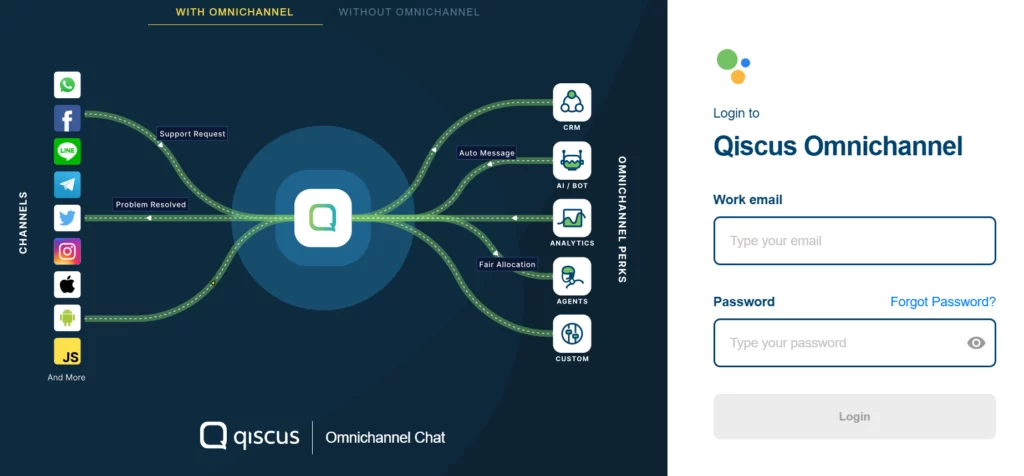
Bringing all your social media conversations into one system gives your team a full view of each customer’s journey. Qiscus Omnichannel Chat integrates Instagram, Facebook Messenger, WhatsApp, and other major platforms into a unified dashboard. This allows your agents to:
- Respond faster
- Maintain consistent communication
- Avoid switching between apps
- Track complete conversation history
With everything in one place, your team works more efficiently and customers receive quicker, more seamless support.
6. Create Standard Operating Procedures (SOP)
Document your standard responses for common questions, outline the steps for each type of complaint, and define your escalation paths.
But remember, customer service SOPs should guide—not replace—human communication. Agents should still personalize their responses to maintain empathy and build a genuine connection with customers.
7. Monitor Sentiment and Comment Trends
Tracking sentiment helps you understand how customers feel and spot early warning signs before issues grow. With Qiscus Omnichannel Chat, you can:
- Monitor sentiment in real time
- Review past chats and comments
- Detect rising negative trends
- Take proactive action before problems escalate
These insights strengthen your service quality and help you protect your brand reputation.
8. Use Visuals to Improve Clarity
Visual guidance often works better than text alone. Screenshots, diagrams, or short videos can make troubleshooting far easier for customers. Always optimize visuals for mobile devices, as most people in Southeast Asia access social media through their phones.
9. Respond to Both Positive and Negative Comments
Don’t only focus on complaints—acknowledge and appreciate positive feedback too.
When handling criticism, respond with empathy and professionalism. Avoid deleting negative comments unless they violate platform guidelines.
Recognize the issue, apologize if needed, and explain the next steps clearly. This shows accountability and earns trust from both the customer and anyone else reading the exchange.
10. Use AI Agents for Common or High-Volume Queries
AI Agents powered by Qiscus AgentLabs help your business respond instantly to frequently asked questions, 24/7. They can automate queries related to:
- Business hours
- Order or booking status
- Return processes
- Product availability
They can also handle more specialized needs like skincare consultations, personalized recommendations, or troubleshooting assistance. Keep your knowledge base updated so the AI Agent always provides accurate and relevant responses.
11. Involve the Marketing Team
Marketing and customer service should never operate in separate lanes. Marketing ensures message consistency and brand alignment, while customer service brings direct, real-world insights from customer conversations. When these two teams collaborate closely—especially during campaigns, promotions, or crisis situations—you gain a powerful advantage:
- Messaging stays consistent
- Responses are unified and credible
- Customer concerns are anticipated earlier
- Internal coordination becomes smoother
A tight partnership between marketing and customer service helps your business respond faster, speak with one voice, and deliver communication that feels coordinated rather than fragmented.
12. Be Proactive—Don’t Wait for Complaints
Great social media service isn’t just reactive; it’s proactive. Actively monitor conversations related to your product category, customer pain points, or industry topics. When you see customers asking questions or searching for solutions, don’t wait—step in with guidance, relevant information, or helpful recommendations.
Proactive engagement shows that your business listens, cares, and takes initiative. It positions your brand as attentive and customer-centric, and it can turn curious prospects into loyal customers long before they submit a formal inquiry.
13. Personalize Every Interaction
Personalization is one of the simplest but most powerful ways to build trust. Use the customer’s name, reference their previous interactions, and adjust your tone to match the situation.
For example:
“Thank you, Mr. Joko. We appreciate your suggestion regarding our new feature.”
These small gestures make customers feel seen, valued, and understood. Over time, personalized interactions strengthen emotional connection and build long-term loyalty—something generic, scripted responses will never achieve.
14. Evaluate Agent Performance Regularly
Consistent evaluation helps maintain high-quality service and ensures your social media team continues to improve. Measure agent performance using clear, objective metrics such as:
- Response time
- Resolution rate
- Tone consistency
- Customer satisfaction
With Qiscus Omnichannel Chat, you get real-time analytics that make performance evaluation easier and more accurate. These insights allow you to identify training gaps, refine SOPs, optimize team allocation, and maintain strong service standards across all social media platforms.
15. Create a Social Media Crisis Response Framework
A crisis can escalate on social media in minutes, and without a clear framework, teams often react slowly or inconsistently. Develop a structured crisis response plan so your team knows exactly what to do the moment an issue surfaces. This framework should cover:
- Approval flows — who signs off responses and in what order
- Ready-to-use key messages — prewritten statements for different crisis scenarios
- Assigned spokespersons — clear ownership of who speaks publicly and who handles internal coordination
- Escalation rules — what gets escalated, to whom, and how fast
- Expected response timelines — defined time limits for acknowledging and resolving high-risk issues
A crisis framework builds discipline and confidence. It minimizes guesswork, reduces delays, and ensures your brand communicates with accuracy, consistency, and control—especially when pressure is at its peak.
16. Implement Social Listening Across the Industry
Social listening goes far beyond tracking your own brand. It allows you to understand the conversations shaping your entire market. Monitor:
- Industry keywords — to see what customers care about and how needs are shifting
- Competitor conversations — to spot gaps you can capitalize on or threats you must address
- Emerging customer trends — to stay ahead of expectations before they become mainstream
With strong social listening, your business can detect early signals of risk, emerging demand, or dissatisfaction—often before competitors even notice. It equips you to make faster, smarter decisions and position your brand strategically in a fast-moving market.
17. Integrate Social Media Interactions Into Your Customer Data Platform (CDP)
Using Qiscus CDP, you can pull every social media interaction—comments, DMs, complaints, positive feedback—into a unified customer profile. This single source of truth gives your business the ability to:
- Personalize communication with context from past interactions
- Analyze long-term behavior patterns to understand what customers value
- Automate targeted engagement, triggered by customer actions or sentiment
- Strengthen retention strategies by identifying at-risk customers before they churn
Integrating social media into your CDP transforms it from a standalone conversation channel into a connected part of the customer lifecycle. Every interaction becomes a data point you can use to improve service quality, deliver relevant experiences, and drive long-term loyalty.
Turn Social Media Into Your Digital Service Advantage
Social media customer service doesn’t just improve the quality of interactions—it strengthens your brand image and boosts customer retention.
Leverage the power of social platforms to deliver service that is more responsive, empathetic, and consistent. Contact Qiscus today to begin transforming your digital customer service experience.