Have you been blasting messages through WhatsApp without seeing real results?
That’s a clear sign it’s time to switch to WhatsApp Marketing Message Optimization (WhatsApp MM Lite)—Meta’s newest solution officially replacing the On Cloud API starting December 1, 2025.
This change isn’t just a technical update. Beginning that date, all Marketing category messages will automatically be sent using WhatsApp Marketing Message Optimization, while Cloud API will remain available only for Utility and Authentication messages.
In other words, this migration isn’t optional—it’s Meta’s new direction for how businesses communicate with customers on WhatsApp.
So, what exactly is WhatsApp Marketing Message Optimization, and why does it matter for your marketing team?
What Is WhatsApp Marketing Message Optimization?
WhatsApp Marketing Message Optimization is Meta’s latest initiative to improve the effectiveness of marketing communication on the WhatsApp Business API.
Using a data-driven approach, Meta now helps identify and prioritize the most relevant audiences—making every promotional message more targeted, efficient, and impactful.
Unlike the Cloud API, WhatsApp Marketing Message Optimization leverages Meta Signals—a rich dataset of customer engagement behavior such as:
- How often customers open or read your messages
- Whether they’ve previously clicked your call-to-action (CTA) buttons
- How they interacted with earlier promotional campaigns
From this data, Meta’s system automatically selects the most promising recipients, ensuring higher message readability and engagement—without overwhelming customers with irrelevant promotions.
Key Features of WhatsApp Marketing Message Optimization
Compared to the traditional Cloud API, WhatsApp Marketing Message Optimization introduces a more intelligent, audience-focused delivery system.
Rather than simply maximizing message volume, it helps businesses reach the right customers at the right moment.
1. Quality-Based Delivery
Instead of sending messages to everyone in your contact list, Meta now evaluates the quality of interactions between your business and each customer.
It considers factors such as message reads, CTA clicks, and past engagement to determine who should receive your next campaign. This ensures that your messages reach active and interested audiences, not inactive contacts who never open your messages.
2. Frequency Capping
One of the biggest challenges in mass messaging is over-communication. To prevent customer fatigue, Marketing Message Optimization includes frequency capping—a limit on how many promotional messages a customer can receive within a certain timeframe.
This feature helps preserve customer comfort, protect your brand image, and maintain long-term engagement.
3. Dynamic Messaging Limits
While the Cloud API uses static delivery limits, Marketing Message Optimization adjusts them dynamically based on campaign performance.
The more customers engage with your messages, the wider your next campaign’s reach becomes. This encourages marketers to focus on quality and relevance, not just quantity.
4. Template Insights & Analytics
Meta now provides richer performance data through Template Insights. Paired with platforms like Qiscus Omnichannel Chat, marketers can monitor campaign performance in real-time—tracking delivered, read, and clicked messages, including CTA effectiveness.
These insights empower marketing teams to conduct data-driven evaluations, run A/B tests, and continuously refine message performance.
5. Time-to-Live (TTL) for Promotional Messages
The Time-to-Live feature lets businesses define how long a promotional message remains active.
For instance, an “11.11 Sale” valid for 24 hours will automatically stop sending after that period—keeping campaigns relevant and preventing outdated promotions from reaching customers. This not only protects customer experience but also reduces unnecessary delivery costs.
6. Creative Optimization & Benchmarking
In the future, Meta will introduce creative optimization—analyzing the performance of different message variations—and provide industry benchmarks to help businesses assess campaign effectiveness.
This helps marketing teams continually refine messaging strategy, from CTA wording and message format to optimal delivery time.
WhatsApp Marketing Message Optimization vs On Cloud API
| Aspect | Cloud API | WhatsApp Marketing Message Optimization |
| Core Function | Send marketing messages to all contacts | Send only to the most relevant and active customers |
| Delivery Approach | Volume-based (mass broadcast) | Quality-based (Meta Signals & engagement) |
| Cost Efficiency | Many unread messages, higher cost | More efficient—sent only to potential audiences |
| Frequency Control | None | Built-in frequency capping |
| Messaging Limits | Static | Dynamic, based on campaign performance |
| Analytics | Limited (sent/read data only) | Comprehensive (clicks, interactions, conversions) |
| Meta Support | Deprecated for Marketing messages | Becomes the new standard as of Dec 1, 2025 |
In short, Cloud API focuses on quantity, while Marketing Message Optimization prioritizes quality and relevance.
With this transition, your business will no longer waste messages on inactive audiences—every message sent will have a clear purpose, measurable result, and improved customer experience.
How to Activate WhatsApp Marketing Message Optimization
To ensure a smooth transition, businesses need to activate the feature before the automatic migration begins. There are two main activation methods:
1. Activation via Meta (WhatsApp Manager)
- Go to App Dashboard → WhatsApp → Quickstart, then select “Get started with Marketing Messages Lite API.”
- Open WhatsApp Manager → Alerts, then click “Accept Terms” to enable the Marketing Messages Lite API for your business account.
- Once activated, all WhatsApp Business Accounts (WABA) under your Business Manager will automatically send marketing messages through Marketing Message Optimization.
- Utility and Authentication messages will still be sent via Cloud API as usual.
2. Activation via Qiscus Omnichannel Chat
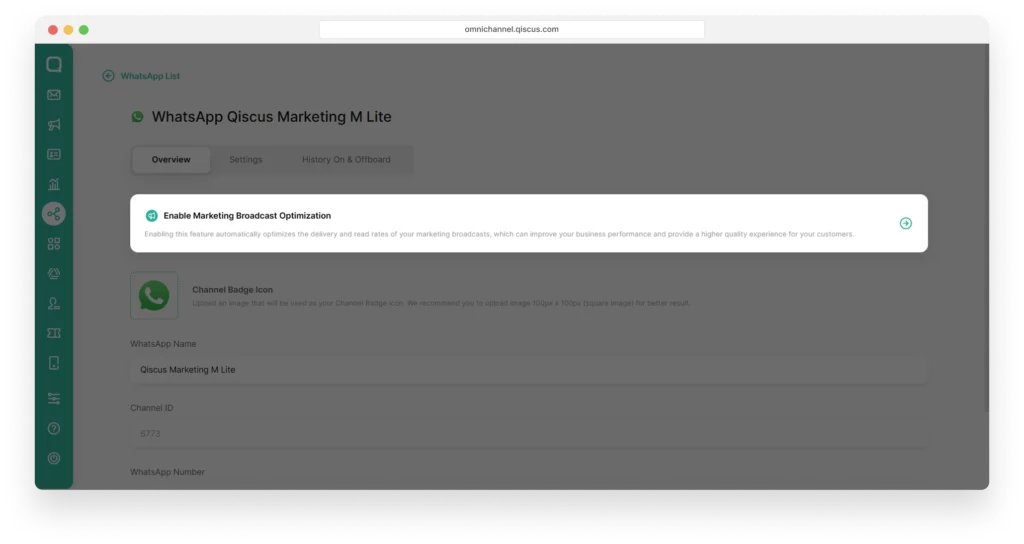
After enabling it on Meta, you can continue activation directly in Qiscus Omnichannel Chat:
- Go to Integration → WhatsApp in the Qiscus dashboard.
- Select your WhatsApp account, then click “Enable Marketing Broadcast Optimization.”
- Complete the Facebook Request Access process to connect and verify your business profile.
- Once approved, your account will display “Marketing Optimization Enabled.”
You can now send marketing broadcasts through Qiscus, and the system will automatically deliver them using WhatsApp Marketing Message Optimization.
Implementation Strategy for WhatsApp Marketing Message Optimization
The goal isn’t just to “send messages via a new system”—it’s to maximize engagement and conversions from every message.
1. Use High-Quality Customer Data
Since Meta’s algorithm depends on engagement signals, clean and relevant data ensures more accurate targeting. Focus on customers who have:
- Previously read your promotional messages
- Frequently clicked CTAs or catalog links
- Recently made a purchase or contacted your team
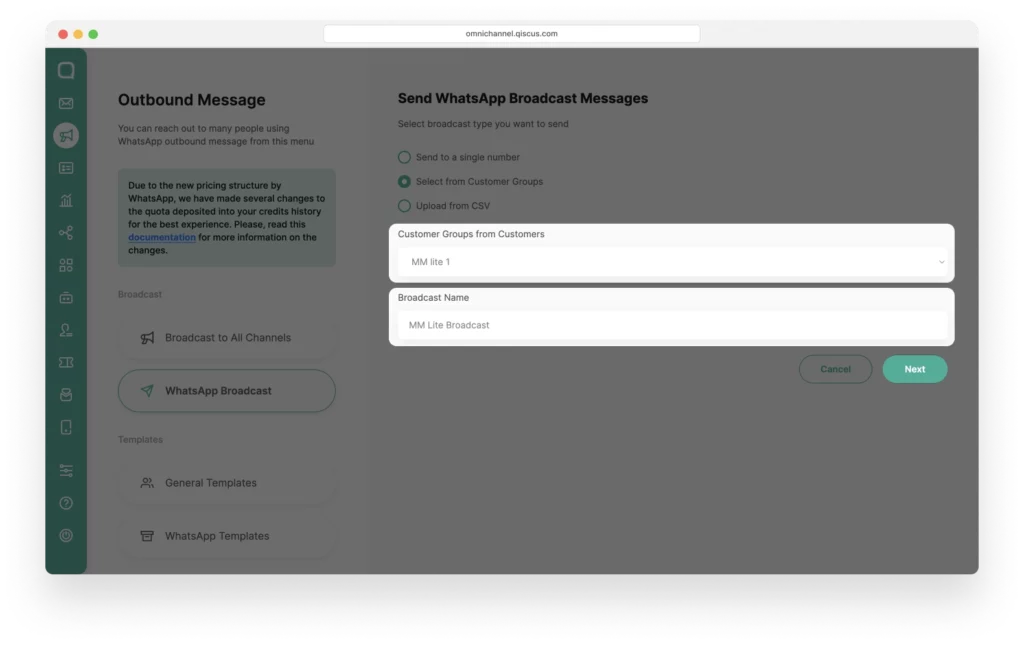
Upload this data via Customer Groups or a CSV file containing active customers. The better your data, the smarter Meta’s targeting becomes.
2. Optimize Your Marketing Templates
Only Marketing category templates can be sent via this feature. Structure your messages to be personal, valuable, and action-oriented. For example:
- Personalized greeting: “Hi [customer name],”
- Clear main offer: “Enjoy 20% off your favorite product today.”
- Specific CTA: “Order now” or “View catalog”
Well-structured templates improve open and click rates—helping Meta register stronger quality signals from your audience.
3. Choose Campaign Objectives Wisely
When sending broadcasts from Qiscus, select the appropriate Objective.
For large-scale or seasonal campaigns, Optimized Mode often delivers better reach and engagement.
4. Run Regular Tests and Evaluations
Monitor key metrics such as:
- Delivery rate
- Read rate
- Click rate
Use these insights for A/B testing—experimenting with message types, CTAs, and timing to find the most effective combination.
5. Let Analytics Drive Your Decisions
With WhatsApp Marketing Message Optimization, you gain more than just delivery numbers—you see actual impact. Use insights from Qiscus dashboards to determine:
- The best time to send messages
- The most effective template formats
- The audience segments driving the highest sales
Real-time visibility helps marketing teams act faster and make smarter, data-driven decisions.
WhatsApp Marketing Message Optimization Pricing
WhatsApp Marketing Message Optimization uses a per-message pricing model, meaning costs are based on successfully delivered messages—not per 24-hour conversation window.
This gives businesses more budget flexibility, paying only for messages that actually reach customers. And because messages are targeted to engaged audiences, your cost per engagement is significantly lower than traditional broadcast methods.
To learn more about official pricing in Indonesia and simulate your campaign costs, contact Qiscus, an official WhatsApp Business Solution Provider (BSP).
WhatsApp Marketing Message Real-World Scenarios
To see how WhatsApp Marketing Message Optimization delivers real results, let’s look at how businesses across different industries have applied it to improve engagement and campaign efficiency.
1. Retail Brand
A fashion brand celebrating its 5th anniversary ran a “Buy 2 Get 1” campaign. Previously, they sent a blast to their full contact list—only 38% of messages were read. With Marketing Message Optimization (Optimized Mode):
- Meta targeted customers who had engaged in the last 60 days and made at least two purchases.
- Frequency Capping limited messages to one every 48 hours.
- TTL set at 24 hours stopped sends once the promo ended.
2. Beauty Clinic
A clinic promoted “20% Off Premium Treatments” to inactive customers (no bookings in 3 months). Using the new system, they:
- Uploaded customer data via CSV.
- Used an approved marketing template.
- Set TTL to 48 hours for a time-bound campaign.
3. B2B SaaS Company
A software firm ran a reactivation campaign for trial users inactive for 30 days.
Previously, click-through rates were 7%. With Marketing Message Optimization:
- Meta targeted users who had clicked demo or webinar links before.
- Message used a short storytelling format with CTA “Try Again Now.”
- Performance was tracked through Template Insights in Qiscus.
4. Food & Beverage Brand
A premium restaurant hosted a “Customer Appreciation Night” in Kuala Lumpur. Using Marketing Message Optimization, they:
- Filtered recipients within a 10-km radius.
- Activated TTL for 12 hours to avoid post-event sends.
- Sent personalized invitations with “Confirm Attendance” CTA.
Move to WhatsApp Marketing Message Optimization Now
Starting December 1, 2025, WhatsApp Marketing Message Optimization becomes the new standard for marketing communications. Messages will now reach the most relevant audience, deliver better performance, and maintain cost efficiency.
If your business hasn’t activated this feature yet or needs guidance for a smooth transition, contact Qiscus for activation support and strategic consultation to maximize your WhatsApp campaign conversions.