Customers expect support in their native language, whether they’re reaching out via WhatsApp, social media, live chat, or email. When language gaps slow down responses or create misunderstandings, frustration builds fast. And in competitive markets like Malaysia and Southeast Asia, especially in the U.S, that frustration often leads to churn.
In this guide, we break down 10 of the best multilingual AI agent tools, how they ai agent work, what makes them effective, and how businesses can choose the right solution for scalable, multilingual customer service.
What Are Multilingual AI Agent Tools?
Multilingual AI agent tools are customer service systems designed to handle conversations across multiple languages and channels with speed and consistency. They go beyond simple translation by understanding language, intent, and context within customer interactions.
These tools automatically detect the language a customer uses from the first message, removing the need for manual language selection and reducing friction at the start of a conversation. Once identified, the AI can respond in the same language or support human agents with context-aware suggestions that follow approved business terminology and tone.
Multilingual AI agents also maintain conversation context across channels such as WhatsApp, social media, live chat, and email. When human support is required, they route conversations to the most suitable agents based on language or issue, ensuring smoother handovers and more efficient resolution.
The Benefits of Multilingual AI Agent Tools
Multilingual AI agent tools make this possible by combining language intelligence, automation, and contextual understanding to deliver seamless customer experiences at scale. Below are the key benefits of using multilingual AI agents in modern customer support operations.
1. Automatically Detect a Customer’s Language
Multilingual AI agent tools can identify the language a customer is using from the very first message. This removes the need for customers to choose a language manually and prevents awkward or incorrect responses. Language detection also speeds up first responses and ensures conversations start on the right footing.
2. Respond or Assist in the Same Language
Once the language is identified, the AI can reply directly in that language or assist human agents with accurate, context-aware responses. Unlike generic translation tools, these responses are aligned with business terminology, tone, and approved knowledge, making interactions feel natural and professional.
3. Route Conversations to the Right Agent When Needed
When a conversation requires human intervention, multilingual AI tools can route it to agents who are best equipped to handle the language or issue. This ensures smoother handovers, faster resolution, and less frustration for both customers and agents.
4. Maintain Conversation Context Across Channels
Customers often switch between WhatsApp, social media, live chat, or email. Multilingual AI agents preserve conversation history and context across these channels, regardless of language. This prevents customers from repeating themselves and allows agents to respond with full understanding of prior interactions.
Unlike basic translation software, multilingual AI agent tools are built specifically for customer service operations. They integrate directly with ticketing systems, escalation workflows, performance analytics, and omnichannel inboxes. As a result, businesses gain not just language coverage, but a structured, scalable way to deliver consistent customer experiences across U.S diverse markets.
10 Best Multilingual AI Agent Tools for Customer Service
To meet these demands without overloading agents or sacrificing quality, many companies are turning to multilingual AI agent tools. Below is a curated list of platforms that businesses commonly evaluate when scaling multilingual customer support, each with different strengths depending on operational needs, channels, and market focus.
1. Qiscus
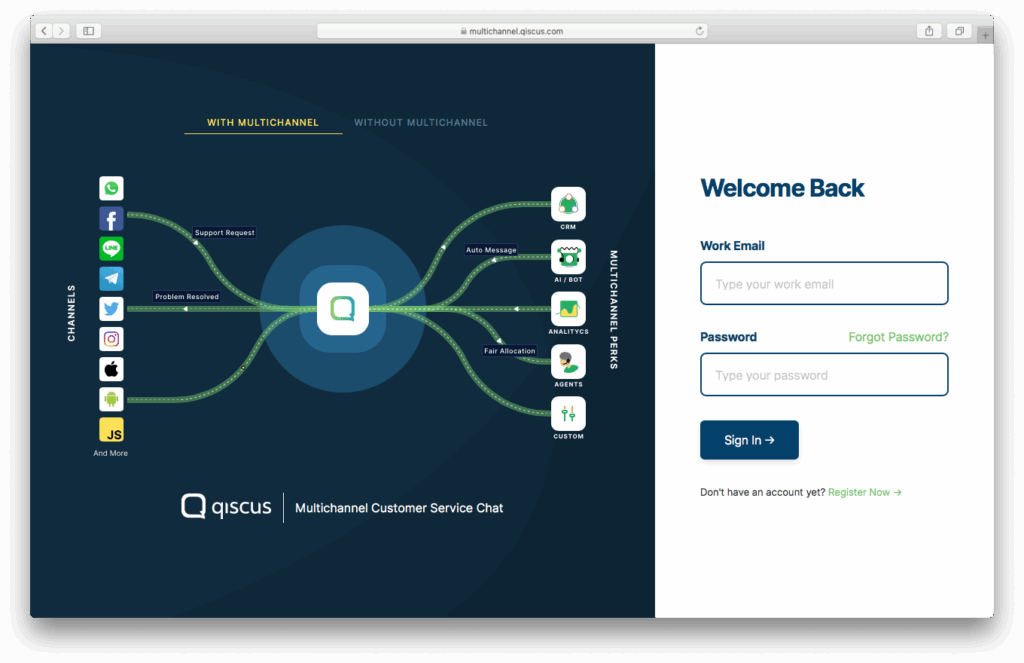
Qiscus is a conversational customer engagement platform built for high-volume, multilingual customer service across WhatsApp, social media, live chat, and more. Its AI capabilities are designed specifically for real-world support operations in Southeast Asia to the U.S.
How it works:
Qiscus AI Agent detects customer language automatically and responds in the appropriate language. For complex issues, conversations are escalated to human agents with full context preserved.
What makes it effective:
- Built for WhatsApp and social media at scale
- AI Agent handles first-level multilingual inquiries
- AgentLabs assists human agents with reply suggestions and summaries
- Centralized dashboard for all channels
Customer benefits:
Faster responses, fewer misunderstandings, and consistent service across languages.
Why it succeeds:
Qiscus combines multilingual AI with real operational workflows, making it practical, not experimental, for enterprise support teams.
Example scenario:
A regional e-commerce brand receives customer messages in English, Bahasa Indonesia, and Bahasa Malaysia across WhatsApp and Instagram. A customer sends a WhatsApp message in Bahasa Indonesia asking about delivery status.
Qiscus AgentLabs automatically detects the language, retrieves the order information, and replies in Bahasa Indonesia within seconds. When the customer follows up with a complaint about a delay, the conversation is escalated to a human agent, who immediately sees the full chat history and context in one dashboard.
Using Qiscus Copilot reply suggestions, the agent responds empathetically and resolves the issue without asking the customer to repeat anything.
This flow ensures the customer feels understood from the first message, while the support team handles multilingual conversations efficiently and consistently across channels.
2. Zendesk
Zendesk supports multilingual customer service through AI-powered bots and translation features integrated into its ticketing system.

How it works:
Zendesk detects language and translates messages for agents, allowing teams to respond across multiple languages.
Strengths:
- Mature ticketing system
- Strong analytics and reporting
- Scalable for large organizations
Limitations:
Multilingual AI capabilities often require add-ons and may not be optimized for WhatsApp-heavy markets.
3. Freshdesk (Freshworks)
Best for growing businesses needing basic multilingual automation. Freshdesk offers multilingual chatbots and translated knowledge bases.
How it works:
Bots detect customer language and provide automated responses before escalating to agents.
Strengths:
- Easy to deploy
- Cost-effective for mid-sized teams
Limitations:
Advanced multilingual handling and conversational depth may be limited compared to specialized platforms.
4. Intercom
Intercom’s AI bots support multilingual conversations primarily for chat-based support.
How it works:
Bots translate and route messages while maintaining conversational context.
Strengths:
- Strong conversational UX
- Good for in-app support
Limitations:
Less optimized for social media and WhatsApp-driven customer service.
5. Tidio
Tidio combines chatbots with live chat and basic multilingual support.
How it works:
Predefined flows are translated into multiple languages.
Strengths:
- Affordable
- Simple setup
Limitations:
Not ideal for complex, high-volume enterprise support.
6. Ada
Ada focuses heavily on AI-driven customer support automation across languages.

How it works:
AI bots handle FAQs and workflows in multiple languages without heavy agent involvement.
Strengths:
- Strong AI automation
- Low agent dependency
Limitations:
Less flexible for nuanced, human-led interactions.
7. LivePerson
LivePerson offers multilingual AI for conversational commerce and support.
How it works:
AI bots handle messaging across channels and languages.
Strengths:
- Enterprise-grade AI
- Strong automation capabilities
Limitations:
Implementation can be complex and costly.
8. Helpshift
Helpshift supports multilingual AI primarily for in-app and mobile messaging.
How it works:
Bots and agents collaborate to resolve issues across languages.
Strengths:
- Mobile-optimized
- Good for app-based businesses
Limitations:
Limited social and WhatsApp support.
9. Salesforce Service Cloud
Salesforce integrates multilingual AI through Einstein AI.

How it works:
AI translates and routes customer inquiries within CRM workflows.
Strengths:
- Deep CRM integration
- Powerful analytics
Limitations:
Heavy setup and less agile for messaging-first markets.
10. Botpress
Botpress allows businesses to build multilingual AI agents from scratch.
How it works:
Developers design language-specific flows and AI behaviors.
Strengths:
- High customization
- Open architecture
Limitations:
More technical and less business-ready out of the box.
Choosing the right multilingual AI agent tool ultimately depends on how your customers communicate and how your support operations are structured. While some platforms focus on translation or ticketing depth, others are designed specifically for real-time, messaging-first environments where speed, context, and consistency matter most.
For businesses operating across regions and languages, the goal is to manage them intelligently, seamlessly, and at scale. And with the right platform in place, multilingual customer service becomes a growth enabler.
Why Multilingual Customer Service Is Hard to Scale
Multilingual customer service becomes less of a competitive advantage and more of an operational necessity. Customers expect to communicate in their preferred language, while still receiving fast, accurate, and consistent support.
A survey including U.S. respondents found that 75% of U.S. consumers surveyed would only spend up to $500 with a brand that doesn’t offer native-language support, and 64% would pay more for brands that do offer support in their native language, underscoring financial impact tied directly to language ability.
The challenge is that language diversity scales much faster than most businesses can realistically handle. Without the right tools, this creates:
1. Slow Response Times
When messages come in across multiple languages, agents often need extra time to understand, translate, or consult internal resources. This slows down first responses and resolution times, even for simple inquiries. These delays are often perceived as poor service rather than language limitations.
2. Inconsistent Translations
Without standardized translation support, different agents may interpret and translate the same message differently. This leads to inconsistent answers, mixed tone, and even conflicting information across channels. Over time, customers lose confidence in the brand’s professionalism and reliability.
3. Overworked Agents
Multilingual demands place additional cognitive load on agents, especially when they are expected to switch languages frequently. This increases fatigue, stress, and the likelihood of errors. As volume grows, burnout becomes a real risk, affecting both performance and retention.
4. Miscommunication that Damages Trust
Small translation mistakes can lead to big misunderstandings, incorrect pricing, wrong instructions, or missed expectations. In customer service, clarity equals trust. When communication breaks down, customers may feel ignored, misled, or unsafe continuing the interaction.
Hiring native-speaking agents for every required language may seem like the solution, but it quickly becomes expensive, difficult to manage, and hard to scale. This is why many growing businesses struggle to maintain multilingual service quality as demand increases. To scale effectively, multilingual support needs to be treated as a system and technology challenge, one that enables consistency, speed, and clarity across every language and channel.
How to Choose the Right Multilingual AI Agent Tool
The right platform should align with how your customers communicate, how your teams work, and how your business plans to scale. With many tools offering “multilingual” capabilities, the real difference lies in how well they support real customer conversations, not just language translation.
When evaluating your options, these key factors will help guide a more informed decision:
1. Primary Channels
Start by understanding where most customer conversations actually happen. Some tools are built primarily for email and web-based ticketing, while others are optimized for real-time messaging. If your customers mainly reach out via WhatsApp, Instagram, or Facebook, you’ll need a platform that handles fast, conversational interactions naturally. Choosing a tool misaligned with your dominant channels often leads to slower responses, fragmented context, and frustrated customers.
2. Languages Needed
Not all multilingual needs are the same. Some businesses require support for a few regional languages, while others need broad global coverage. Consider whether the tool understands local language nuances, informal phrasing, and mixed-language conversations. Strong multilingual AI should go beyond literal translation and support how customers actually speak in everyday interactions.
3. Conversation Volume
Daily conversation volume has a direct impact on tool performance and ROI. High-volume environments require AI that can handle thousands of simultaneous conversations without delays or quality drops. A solution that works well at low volume may struggle during campaigns, peak seasons, or rapid growth, leading to bottlenecks and inconsistent service.
4. AI Maturity
Multilingual AI tools vary in how they support teams. Some focus mainly on full automation, while others act as intelligent assistants for human agents. The most effective solutions balance both, automating repetitive inquiries while supporting agents with context, suggestions, and summaries. Understanding how much autonomy you want to give AI helps avoid over-automation or underutilization.
5. Operational Simplicity
Even the most advanced AI tool will fail if it’s too complex to adopt. Look for platforms that are easy to configure, train, and update without heavy technical involvement. Fast onboarding, intuitive workflows, and minimal disruption to existing processes make it easier for teams to embrace AI and use it consistently.
These considerations are even more critical. Customers tend to communicate informally, switch channels frequently, and expect fast, human-like responses, especially on messaging platforms. Tools designed around traditional enterprise workflows often fall short in these environments.
This is where platforms like Qiscus stand out. By combining multilingual AI agents, agent assistance through AgentLabs, and true omnichannel conversation management in one unified system, Qiscus enables teams to deliver consistent, scalable, and culturally relevant customer experiences.
Scale Multilingual Support Without Losing the Human Touch
As customer bases grow more diverse, multilingual AI agents become essential to strengthen human interaction. The right AI platform enables businesses to respond faster, stay consistent across languages, and support teams under pressure, all while keeping conversations natural and empathetic. When multilingual support is done well, customers feel understood.
With Qiscus Copilot and AgentLabs, businesses can break language barriers without adding operational complexity. AI handles first-level multilingual conversations across WhatsApp and social media, while human agents step in with full context when it matters most.
Ready to scale multilingual customer service the smarter way? Hit us up, today!