Malaysian customers do not call anymore. They WhatsApp. Seven in ten Malaysian consumers prefer messaging a business over calling or emailing, and 92% specifically prefer WhatsApp over phone calls for customer service.
If your team is still handling every one of those messages manually, you already know the problem: response times slip, leads go cold, and agents spend most of their day answering the same five questions on repeat.
The best WhatsApp chatbot for a Malaysian business is not the one with the longest feature list. It is the one that fits how Malaysian customers actually communicate, multilingual, mobile-first, and expecting a reply in under five minutes.
This guide covers 21 platforms worth evaluating, what makes each one relevant (or not) for the Malaysian market, and how to choose based on what your business actually needs.
What Is a WhatsApp Chatbot?
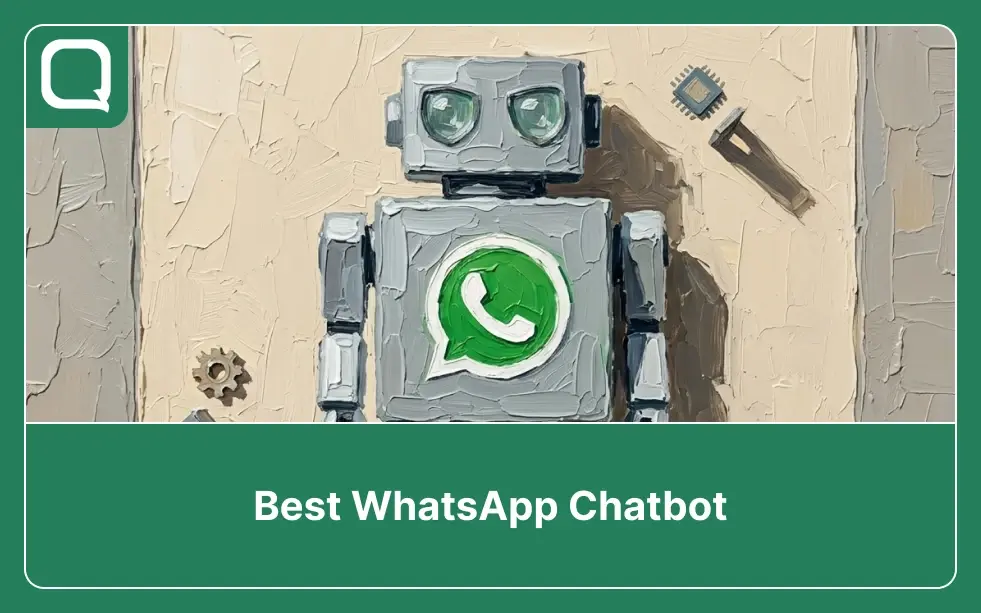
A WhatsApp chatbot is an automated messaging system connected to a WhatsApp Business account via the WhatsApp Business API that handles customer conversations in real time, without a human agent responding to every message.
The distinction worth understanding upfront: a WhatsApp chatbot is not the basic auto-reply function in the WhatsApp Business app. That app is designed for micro-businesses, single device, no team inbox, no automation beyond pre-set quick replies.
A proper WhatsApp chatbot runs on the WhatsApp Business API from Meta, which unlocks multi-agent access, automated conversation flows, broadcast messaging, and integration with your CRM and other business systems.
Three types of WhatsApp chatbot are in common use:
1. Rule-based chatbots follow scripted flows, effective for FAQs, appointment booking, and order confirmations.
2. AI-based chatbots use Natural Language Processing (NLP) and Large Language Models (LLMs) to understand intent and respond naturally across unpredictable conversation paths.
3. Hybrid chatbots combine both, structured flows for routine queries, AI for everything else. Most mid-market and enterprise deployments in Malaysia use the hybrid model.
For Malaysian businesses specifically, one additional requirement stands out: the ability to handle conversations in multiple languages. A chatbot that switches fluently between Bahasa Melayu, English, Mandarin, and Tamil within a single customer interaction is not a nice-to-have in this market. It is a genuine operational need.
Why Malaysian Businesses Need a WhatsApp Chatbot
Malaysia’s digital communication landscape is one of the most WhatsApp-intensive in the world. With over 34.9 million internet users and more mobile connections than people, the channel dynamics here are distinct from other markets.
1. WhatsApp Is How Malaysians Do Business
WhatsApp is not just a consumer messaging app in Malaysia, it is the primary channel for sales inquiries, customer support, appointment booking, and order follow-ups across virtually every industry.
Businesses that are slow on WhatsApp lose customers to competitors who are fast. The channel creates a direct, personal connection that email simply cannot replicate, which is why 92% of Malaysian consumers prefer it for customer service interactions.
2. The Multilingual Market Demands Flexible Communication
Malaysia’s population communicates in Bahasa Melayu, English, Mandarin, and Tamil, sometimes within the same conversation. A customer who starts a query in English and switches to Mandarin mid-thread is not an edge case in Malaysia.
It is everyday reality. WhatsApp chatbots with multilingual Ai agent capability handle this naturally, while rule-based bots with fixed language flows create friction that costs businesses customers.
3. Malaysian Consumers Are Increasingly AI-Native
Based on existing research, 58% of Malaysian consumers already use AI tools in their shopping journeys, and more than half purchase directly through social platforms. Customers in this market have normalized AI-assisted interactions faster than most.
They are less resistant to chatbot-first interactions, provided the chatbot actually resolves their query rather than deflecting it.
4. Repetitive Queries Dominate Inbound Volume
Across Malaysian SMEs, 60 to 70 percent of inbound WhatsApp messages are repetitive: operating hours, pricing, delivery coverage, product availability, appointment slots. These queries consume significant agent time but require no human judgment. A well-configured chatbot handles them instantly, 24 hours a day, freeing agents for conversations that actually benefit from human involvement.
5. WhatsApp Business API Scales With Your Business
The standard WhatsApp Business app caps out quickly, one device, no automation, no multi-agent support. As Malaysian businesses grow, the API removes every one of these constraints: multiple agents on one number, broadcast campaigns to segmented lists, verified template messaging, and integration with the systems you already use.
Taken together, these five factors make WhatsApp chatbot automation not just a productivity improvement for Malaysian businesses, it is a competitive necessity. The longer a business waits, the wider the gap grows between them and competitors who are already responding in seconds.
WhatsApp Chatbot vs AI Agent: What’s the Difference?
Before comparing platforms, it helps to be clear on what capability level your business actually needs. Most vendors use “chatbot” and “AI Agent” interchangeably — but they are fundamentally different systems.
| Dimension | WhatsApp Chatbot (Rule-Based) | AI Agent (LLM-Powered) |
| How it works | Follows pre-programmed conversation flows | Understands context and intent dynamically |
| Response flexibility | Limited to scripted scenarios | Handles unexpected questions and multi-turn conversations |
| Multilingual handling | Requires separate language flows | Understands and responds across languages contextually |
| Personalization | Minimal | High — adapts based on customer data and conversation history |
| Setup complexity | Lower — visual flow builder | Requires knowledge base training and configuration |
| Best for | FAQs, notifications, structured flows | Product consultation, lead qualification, complex support |
| Example | Menu chatbot (reply 1 for pricing, 2 for support) | Qiscus AgentLabs AI Agent |
For Malaysian businesses with a diverse customer base speaking different languages, AI-based or hybrid chatbot for WhatsApp Business deliver significantly better outcomes than rule-based systems. A rule-based chatbot that requires customers to navigate a fixed menu in one language creates drop-off. An AI Agent that understands intent in whatever language the customer uses does not. For a practical guide on building a WhatsApp AI Agent from scratch, see our step-by-step walkthrough.
21 Best WhatsApp Chatbot Platforms for Malaysia
The platforms below are evaluated on WhatsApp Business API access, AI capability, multilingual support, and practical fit for business contexts ranging from SME to enterprise. Qiscus appears first with the most detailed coverage. All other platforms are presented concisely.
1. Qiscus (WhatsApp Business API + AgentLabs)
Qiscus is an agentic customer engagement platform that pairs official WhatsApp Business API access with Qiscus AgentLabs, an LLM-powered AI Agent built for businesses that need intelligent, context-aware WhatsApp automation beyond what a scripted chatbot can deliver.
For Malaysian businesses, the combination is particularly relevant. WhatsApp Business API access through Qiscus is handled via an official Meta BSP relationship, which means account compliance, volume handling, and template approval are managed correctly from day one.
AgentLabs handles multilingual conversations natively, manages multi-turn interactions without losing context, qualifies leads through structured dialogue, and hands off to human agents with the full conversation summary intact.
Through WhatsApp Business API, Qiscus enables businesses to run a single WhatsApp number with multiple agents simultaneously, send broadcast messages and verified notifications at scale, and route all conversations into the Qiscus Omnichannel Chat unified inbox alongside other channels, managed from one dashboard.
AgentLabs functions as an intelligent layer above this infrastructure. It processes inbound messages using LLM reasoning, generates responses grounded in your business knowledge base, and escalates contextually when human judgment is needed.
When the handover happens, the receiving agent sees the full conversation history, an AI-generated summary, and suggested responses.
Proven results in the region: KPJ Healthcare achieved 88% booking conversion and scaled patient engagement using Qiscus. Panorama JTB cut response time by more than 70% after implementing Qiscus across their customer communication workflow.
Best for: Mid-market and enterprise businesses in Malaysia that need official WhatsApp API access, multilingual AI conversation capability, and an integrated customer engagement platform.
2. Trengo
Trengo consolidates WhatsApp, email, Instagram, and other channels into one team inbox. Its automation covers triage, routing, and rule-based replies. Stronger on team collaboration and inbox management than on AI conversation depth.
Best for: Customer service teams that need a unified inbox across WhatsApp and other channels with practical routing automation.
3. Verloop.io
A conversational AI platform built for high-volume customer service teams. Routes conversations based on detected intent, supports seamless bot-to-human escalation, and handles multi-channel communication including WhatsApp. No free trial or freemium tier.
Best for: Enterprise customer service teams that need intent-based routing and AI triage across large message volumes.
4. Kommunicate
AI chatbot platform focused on the quality of bot-to-human handoff. Intuitive interface, live conversation dashboard, and 40+ integrations. Known for smooth escalation workflows and real-time supervisor visibility.
Best for: Mid-market customer service teams that prioritize seamless bot-agent handoff and live conversation monitoring.
5. AiSensy
WhatsApp-first platform combining broadcast campaigns, AI automation, and CRM integrations. Popular with D2C and e-commerce brands for marketing-led WhatsApp use cases. Primarily built for the Indian market but applicable to Malaysian businesses with similar needs.
Best for: E-commerce and D2C businesses that run WhatsApp primarily as a marketing and broadcast channel.
6. UChat
Multi-channel chatbot builder that supports WhatsApp, Facebook, Telegram, and 12 other channels. A single chatbot deploys across all channels simultaneously. Includes WhatsApp catalog integration for e-commerce. Higher learning curve than simpler platforms.
Best for: Businesses that want to deploy one chatbot across multiple messaging platforms including WhatsApp without rebuilding flows per channel.
7. SleekFlow
SleekFlow is an omnichannel messaging platform with strong adoption among Malaysian and regional SMEs. Its visual flow builder, broadcast tools, and multilingual support make it accessible to non-technical teams. Well-suited for businesses running customer service and WhatsApp marketing from one platform.
Best for: Malaysian SMEs that want WhatsApp automation with solid broadcast and segmentation capabilities and locally familiar support.
8. WATI
A widely adopted WhatsApp-first platform for SMBs. WATI’s no-code chatbot builder, pre-built templates, and shared team inbox make it fast to deploy. AI capabilities are primarily support-focused. An 8% API markup adds up at high volume.
Best for: Malaysian SMBs that want a working WhatsApp chatbot within days and do not yet need advanced AI or complex integrations.
9. Chatbase
Chatbase specializes in training AI chatbots on your own business data — upload documents or link your website and the bot learns your content quickly. Multilingual support and omnichannel deployment across WhatsApp, Instagram, and web. Limited customization depth for complex workflows.
Best for: Businesses that need fast AI-powered FAQ deflection on WhatsApp without complex setup.
10. Yellow.ai
Conversational AI platform for enterprise-grade automation across WhatsApp and other channels. Strong NLP, multilingual support, and enterprise integration capabilities. Designed for large-scale deployments with dedicated implementation support.
Best for: Large enterprises requiring sophisticated multi-channel conversational AI with extensive language and system integration support.
11. Freshchat (Freshdesk)
Part of the Freshworks ecosystem. Freddy AI provides suggested replies, conversation summaries, and automated responses across WhatsApp and other channels. Integrates tightly with Freshdesk ticketing for support teams.
Best for: Businesses using Freshdesk for customer support that want WhatsApp automation within the same ecosystem.
12. Respond.io
Headquartered in Kuala Lumpur, Respond.io unifies WhatsApp, Facebook Messenger, Instagram, Telegram, and more into a single inbox with AI Agents, workflow automation, and CRM-style contact management. Strong on sales-led automation for businesses where WhatsApp drives revenue, not just support.
Best for: Sales-driven Malaysian businesses managing multi-channel customer conversations that need CRM integration and locally available support.
13. Gupshup
An enterprise messaging platform with direct WhatsApp Business API access and NLP-based conversation tools. Designed for technical teams that need deep customization and reliable API infrastructure at scale. Not a plug-and-play solution.
Best for: Malaysian enterprises with in-house development teams that need powerful API infrastructure and custom conversation flow control.
14. Botpress
An open-source chatbot platform powered by LLMs from multiple providers. Highly customizable through JavaScript, with over 190 integrations available and strong WhatsApp API support. Requires developer resources to build and maintain.
Best for: Technical teams in Malaysia that want full control over chatbot logic and deep integration with internal systems.
15. Landbot
Landbot focuses on visual, no-code conversation design. Non-technical teams can build structured multi-step WhatsApp flows with branching logic and CRM webhooks. Conversational experience feels more like a guided form, less suited for open-ended AI conversations.
Best for: Marketing and operations teams that need structured WhatsApp flows for lead capture, onboarding, and survey collection.
16. Bird (formerly MessageBird)
An omnichannel communication platform combining WhatsApp, SMS, email, and voice with a pay-as-you-go model. Enterprise-grade infrastructure with strong broadcast volume capabilities. Some costs are not obvious in base rates.
Best for: Enterprises that need high-volume multi-channel messaging with programmatic API access.
17. ManyChat
ManyChat is built for marketing automation across WhatsApp, Instagram, and Facebook Messenger. Its drag-and-drop builder and broadcast tools are beginner-friendly. AI features are available on higher plans. Limited depth for complex support use cases.
Best for: Small businesses and marketing teams focused on WhatsApp broadcast campaigns and lead capture automation.
18. Tidio
Tidio combines live chat, AI, and e-commerce integrations in one platform. Its Lyro AI assistant handles FAQ deflection using your knowledge base. WhatsApp integration requires a higher-tier plan. Strong Shopify and WooCommerce connectivity.
Best for: E-commerce businesses in Malaysia wanting WhatsApp automation tied directly to their online store.
19. Infobip
A global enterprise communication platform with WhatsApp Business API, SMS, email, and voice in one infrastructure. Official Meta BSP with strong SLA guarantees and multi-country coverage. Requires enterprise contracts and longer onboarding timelines.
Best for: Large enterprises with multi-country operations in SEA that prioritize compliance, uptime, and regulatory coverage.
20. Intercom
Intercom’s Fin AI resolves a high proportion of support queries autonomously using your knowledge base. Its WhatsApp integration sits within a broader support and engagement suite that includes live chat, email, and in-app messaging.
Best for: Businesses already on Intercom for multi-channel support that want to extend AI-powered service to WhatsApp without switching platforms.
21. Twilio
Developer-first communication infrastructure with WhatsApp Business API access through the Twilio Messaging API. Gives engineering teams full programmatic control over every aspect of the chatbot. No ready-to-use interface for non-technical users.
Best for: Technical teams building fully custom WhatsApp automation on top of existing business architecture.
Every platform on this list offers a different trade-off between ease of use, AI depth, customization, and cost. The right starting point is not the most feature-rich option, it is the one that matches your team’s technical capacity, your customers’ language needs, and your business’s conversation complexity today, with room to grow.
How to Choose the Right WhatsApp Chatbot for Your Business
Platform selection for a Malaysian business involves a few considerations that do not always appear in global comparison guides.
1. Confirm Official WhatsApp Business API Access
This is non-negotiable. Any platform not operating through the official WhatsApp Business API or a verified Meta BSP is a compliance risk. Account suspensions from unofficial tools are not recoverable. Verify BSP status before evaluating any other capability. Our guide on choosing a WhatsApp Business API provider covers the exact verification steps.
2. Evaluate Multilingual Capability Seriously
In Malaysia, multilingual support is not a feature to check off, it is a core operational requirement. Test any shortlisted platform specifically on how it handles language-switching mid-conversation. Rule-based chatbots with separate language flows create customer friction. AI-based systems that understand intent regardless of language do not.
3. Match AI Depth to Your Conversation Complexity
Not every Malaysian business needs an LLM-powered AI Agent. A retail store with high FAQ volume and predictable queries may get everything it needs from a well-configured rule-based chatbot. A financial services firm managing complex product inquiries and lead qualification over WhatsApp needs genuine AI capability. Be honest about your conversation complexity before paying for capability you will not use.
4. Assess Integration with Your Existing Systems
A WhatsApp chatbot that cannot connect to your CRM, order management system, or appointment scheduler is a generic response machine. The value compounds when the chatbot can pull customer-specific data and give a relevant, personalized answer. Map your required integrations before committing to a platform.
5. Understand Total Cost Including API Markup
WhatsApp chatbot costs in Malaysia have two components: the platform subscription and Meta’s per-conversation API charges. Some platforms add a markup of 8 to 25 percent on API costs. At high message volumes, this markup becomes a significant line item. Ask every vendor explicitly about their API pricing model before signing a contract.
6. Factor in Local Support Quality
A platform with excellent global documentation but no regional support can be slow and frustrating when something breaks during peak periods. For Malaysian businesses, a vendor with local support coverage, available during Malaysian business hours is often underestimated until it is needed.
Run through these six criteria before signing any contract. A platform that scores well across all six is the right platform. A platform that scores perfectly on one but fails on multilingual capability or API compliance is the wrong one, regardless of how impressive the demo looks.
How to Get Started
Most successful WhatsApp chatbot implementations in Malaysia start smaller than expected and expand faster than planned.
1. Categorize Your Current WhatsApp Conversations
Before choosing a platform, spend 30 minutes categorizing your last month of WhatsApp messages. What percentage are repetitive? What languages are customers writing in? Where do response delays actually happen? This audit determines your real requirements.
2. Activate WhatsApp Business API Through a Verified BSP
The foundation is a properly activated WhatsApp Business API account. This requires business verification through Meta Business Manager and number approval. A BSP like Qiscus handles this process including template pre-approval and compliance setup.
3. Build Your First Three Automation Flows
Identify the three most frequent, most repetitive conversation types in your WhatsApp inbox and automate those first. For most Malaysian businesses, this means pricing inquiries, appointment or demo requests, and basic product FAQs. Measure deflection rate after two weeks. Add more flows once the foundation is stable.
4. Connect Your Chatbot to Your Business Data
Connect your WhatsApp chatbot to your CRM, helpdesk, or order system so it can give specific answers to specific customers — not generic responses to everyone. This is what separates a chatbot that frustrates customers from one that retains them.
5. Define and Test Your Escalation Logic
Map out exactly which conversation types should always reach a human agent, at what point, and with what context transferred. Build and test this before going live. In Malaysia’s relationship-driven business culture, a fumbled escalation costs more than a slow first reply.
Follow these five steps in sequence and your implementation will be on solid ground from day one. Skip any of them, especially step one and step five, and you will spend the first three months fixing problems that were entirely preventable.
Your Customers Are Already on WhatsApp
In Malaysia, WhatsApp is not a channel businesses are choosing to adopt. It is the channel customers already expect you to be available on, instantly, personally, and in their preferred language.
The businesses pulling ahead are not the ones spending more on marketing. They are the ones who respond in seconds instead of hours, qualify leads before they go cold, and never make a customer repeat their question because context was lost in a shift handover.
The right WhatsApp chatbot does not replace your team. It gives your team the capacity to focus on the conversations that actually require them.
Get in touch with the Qiscus team to find out what a WhatsApp chatbot built for your business complexity looks like in practice.
Frequently Asked Questions
These are the questions Malaysian businesses most commonly ask before committing to a WhatsApp chatbot platform. If your question is not here, it is likely covered in the platform entries or the selection criteria section above.
Yes, provided you operate through the official WhatsApp Business API via a verified Meta BSP. Tools that bypass WhatsApp’s terms of service risk permanent account suspension and potential violations of Malaysia’s Communications and Multimedia Act. Always use official API access.
It depends on the platform. Rule-based chatbots typically require separate language flows, which adds setup complexity and creates friction when customers switch languages mid-conversation. AI-based chatbots using modern LLMs understand and respond in Bahasa Melayu, English, Mandarin, and Tamil without requiring separate configurations — the more practical solution for Malaysian businesses.
WhatsApp Business is a free app for small businesses, one device, no automation, no multi-agent support. WhatsApp Business API is the enterprise version that enables multiple agents, programmatic automation, broadcast campaigns, and system integration. Any chatbot deployment beyond basic auto-replies requires the API.
Total cost includes the platform subscription and WhatsApp API conversation costs set by Meta, which vary by message category and destination. Some platforms add a markup of 8 to 25 percent on API costs. For accurate pricing relevant to Malaysian conversation volumes, request quotes directly from shortlisted vendors.
A basic rule-based chatbot can be live within a few days of API activation. An AI Agent with knowledge base training, CRM integration, and multilingual configuration typically takes two to four weeks.
If you have further questions specific to your business size, industry, or WhatsApp conversation volume, the most accurate answers will come from a direct conversation with a vendor whose platform matches your profile.