Most businesses believe they deliver a great experience—until customers tell them otherwise. A customer satisfaction survey is one of the most effective ways to uncover what customers truly think, why they stay, why they leave, and what would make them more loyal.
In fast-growing markets like Malaysia and Southeast Asia, where consumer expectations are rising and competition is intense, companies need more than assumptions or sporadic feedback—they need structured, actionable insight.
This article explains what a customer satisfaction survey is, why it matters, different types you can use, and how to design one that actually improves experience and performance.
What is a Customer Satisfaction Survey?
A customer satisfaction survey is a structured questionnaire designed to measure how satisfied customers are with your products, services, or overall brand experience. It helps businesses understand customer sentiment, identify areas for improvement, and evaluate whether they are meeting expectations.
A typical customer satisfaction survey collects feedback on:
- Service quality
- Staff performance
- Ease of use
- Product performance
- Value for money
- Overall experience
A good survey goes beyond collecting responses. It provides actionable data that directly influences product, service, and operational decisions.
Benefits of Customer Satisfaction Surveys
A well-designed customer satisfaction survey doesn’t just capture opinions—it uncovers insights that directly influence experience, loyalty, and business performance. Below are key benefits businesses can expect when they consistently listen to their customers.
1. Improves Customer Experience
Customer feedback highlights friction points in the journey and reveals what customers value most.
With real data, businesses can identify pain points, eliminate bottlenecks, and prioritize high-impact improvements that matter to customers—whether it’s speed, convenience, service quality, or product usability. A better experience leads to higher satisfaction and repeat engagement.
2. Increases Retention and Loyalty
Acquiring new customers is expensive, while retaining satisfied customers is far more profitable. Surveys help organizations identify at-risk customers, predict churn, and proactively address dissatisfaction before it escalates.
When businesses respond quickly and meaningfully, they strengthen loyalty and reduce the cost of winning back lost customers.
3. Enhances Product and Service Quality
Customer satisfaction surveys help companies validate ideas, test new features, and improve offerings based on actual needs rather than assumptions. This insight-driven approach minimizes wasted investment, accelerates product development, and ensures that updates deliver measurable value to customers.
4. Strengthens Brand Reputation
Customers trust brands that actively listen and respond to feedback. When businesses collect, acknowledge, and act on customer input, they demonstrate transparency and accountability.
Communicating these actions publicly helps build a positive reputation, differentiate from competitors, and foster long-term customer confidence.
5. Supports Strategic Decision-Making
Customer satisfaction data empowers leaders to make evidence-based decisions that affect core business initiatives, including resource allocation, pricing strategy, market positioning, and customer experience programs.
In competitive markets like Malaysia and Singapore, data-driven strategies are essential to maintain relevance, capture growth opportunities, and outperform competitors.
Types of Customer Satisfaction Surveys
Selecting the right survey depends on your objectives—whether you want to understand immediate satisfaction, long-term loyalty, ease of interaction, or overall perception of your brand. Below are the most commonly used survey types and when they work best.
1. CSAT (Customer Satisfaction Score)
CSAT measures short-term satisfaction with a specific interaction, making it ideal for capturing immediate reactions. Respondents typically rate their experience on a scale from 1–5 or 1–7.
Example question:
“How satisfied were you with your experience today?”
Best for: retail, customer service, support interactions, or any moment where you want to evaluate service quality immediately after a touchpoint.
2. NPS (Net Promoter Score)
NPS measures long-term customer loyalty and brand advocacy, making it a strategic indicator of future business growth. It predicts whether customers are likely to recommend your brand.
Example question:
“How likely are you to recommend us to a friend or colleague?”
Responses are scored from -100 to +100, where higher scores indicate stronger loyalty and advocacy.
3. CES (Customer Effort Score)
CES measures how easy it was for customers to complete a task or resolve an issue, which is a powerful predictor of satisfaction and loyalty. Lower effort often translates into higher retention.
Example question:
“How easy was it to resolve your issue today?”
Best for: digital products, service teams, and customer support operations focused on improving efficiency and reducing friction.
4. Post-Transaction Surveys
Post-transaction surveys are triggered immediately after a specific interaction, such as a purchase, delivery, support call, or service appointment. They provide contextual, real-time feedback that helps organizations evaluate performance at critical touchpoints.
Best for: identifying immediate customer reactions and uncovering opportunities for quick service recovery.
5. Longitudinal / Annual Surveys
Longitudinal surveys gather a deep, holistic assessment of customer sentiment over an extended period. They support strategic decisions such as planning, benchmarking, and stakeholder reporting.
These surveys are commonly used in industries like banking, telecom, and utilities where businesses must track customer perception and meet compliance or service standards consistently.
How to Create a Customer Satisfaction Survey
A well-designed survey collects meaningful responses, reduces bias, and produces insights that drive measurable improvements. Follow these essential steps to build a survey that delivers real business impact.
1. Define Clear Goals
Start by identifying what you want to learn and why it matters. Clear goals ensure your survey is targeted, relevant, and capable of producing actionable results, not just interesting data.
You may want to:
- Improve service response times
- Validate new product features
- Measure overall customer loyalty
- Reduce churn and dissatisfaction
When goals are defined upfront, your questions become more focused, and your analysis becomes more effective.
2. Choose the Right Metrics
Select customer service metrics that align with your objectives. The right measurement framework helps you quantify performance and track progress consistently over time.
Examples of commonly used metrics:
- CSAT for transactional satisfaction
- NPS for brand loyalty
- CES for service efficiency
Many companies combine multiple metrics to capture both immediate sentiment and long-term loyalty.
A survey platform like Qiscus Survey can simplify this process by providing ready-to-use rating scales for CSAT, NPS, CES, and other custom metrics, so teams don’t need to design measurement models from scratch. Scores are computed automatically and displayed in a central dashboard, making it easier to monitor performance without manual number crunching.
3. Design Clear, Neutral Questions
Survey questions should be clear, neutral, and considerate of the customer’s context to avoid leading respondents toward a particular answer. When questions are confusing or suggestive, the results become less reliable and harder to interpret, which can undermine the very purpose of collecting feedback.
Example of a neutral question:
“How satisfied are you with the delivery time?”
Example of a biased question:
“How amazing was our fast delivery?”
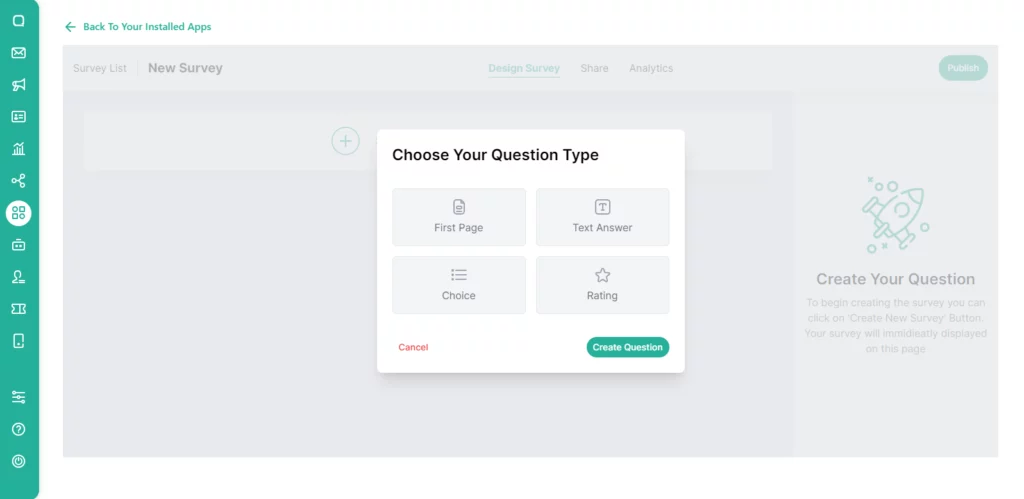
Tools like Qiscus Survey can make this easier by offering pre-built templates based on established survey design principles, helping teams phrase questions in a balanced and unbiased way.
It also supports multiple input formats—such as rating scales, multiple-choice, and open text—so that surveys can gather both quantitative and qualitative data without sacrificing clarity.
4. Select the Right Distribution Channel
Choosing the right channel is critical because even well-designed surveys will fail if customers don’t see or respond to them. Traditional options like email often suffer from low open rates and delayed responses, especially in markets where customers prefer mobile-first communication.
As an alternative, survey tools that integrate with official WhatsApp Broadcast allow businesses to distribute surveys directly to customers through a channel they actively use. By sending survey links or prompts via broadcast messages, businesses can reach a wide audience quickly, improve open rates, and collect feedback in real time.
This approach reduces friction and makes participation feel effortless, ultimately increasing the volume and quality of responses.
5. Incentivize Responsibly
Rewards can boost participation, but over-incentivizing can create bias or attract respondents who don’t reflect your target audience. Keep incentives small, neutral, and aligned with business values.
Possible incentives:
- Vouchers
- Loyalty points
- Lucky draw entries
The purpose of incentives is to encourage honest participation—not to influence the outcome.
6. Analyze Data and Take Action
Effective analysis involves segmenting responses, identifying recurring issues, prioritizing high-impact actions, assigning responsibility, and communicating progress back to customers.
A tool like Qiscus Survey can support this process by consolidating results into real-time dashboards and enabling performance to be viewed by product, agent, branch, channel, or customer segment.
By turning feedback into timely actions and closing the loop with customers, businesses can improve operations and strengthen trust over time.
10 Customer Satisfaction Survey Use Cases
Below are common customer experience scenarios where surveys can be used to measure satisfaction, detect friction, or identify opportunities. You can adapt these use cases to fit your products, services, or channels.
| Use Case / Outcome | When to Ask | Example Question | Metric / Insight Type |
| Measure overall experience | After a transaction or interaction | How satisfied are you with your recent experience with us? | CSAT / Overall satisfaction |
| Assess ease of purchase or access | After completing a task, purchase, or onboarding | How easy was it to purchase or access our service? | CES / Usability & friction |
| Understand likelihood of referral | Periodically, or after a positive experience | How likely are you to recommend us to others? | NPS / Advocacy & loyalty |
| Evaluate customer support quality | After case resolution | How satisfied are you with our customer support team? | CSAT / Service performance |
| Assess staff friendliness | After face-to-face or human interaction | How friendly and helpful was the staff? | Service quality / Human interaction |
| Measure value for money | After purchase or usage | How satisfied are you with the product’s value for money? | Pricing perception / Value alignment |
| Identify improvement opportunities | At the end of the survey | What could we do to improve your experience? | Qualitative insight / Root causes |
| Evaluate speed of service | After completion of service or support | How satisfied are you with the speed of service? | Operational efficiency |
| Predict repeat purchase | After usage or renewal period | How likely are you to buy from us again in the future? | Retention / Future behavior |
| Collect general feedback | At the end of the interaction | Do you have any additional feedback or suggestions? | Open-ended insight |
These use cases help you choose the right question at the right moment based on the outcome you want to measure—whether it’s satisfaction, loyalty, efficiency, or improvement. Keeping questions short, neutral, and context-specific will make feedback easier to analyze and more actionable for your team.
Turning Feedback Into Better Experiences with Qiscus
A structured customer satisfaction survey helps businesses understand what customers value, where friction occurs, and which improvements will have the greatest impact.
By choosing the right metrics, asking clear questions, and using effective distribution channels, businesses can turn feedback into practical actions that strengthen satisfaction and loyalty over time.
If you’re ready to scale feedback collection, automate workflows, or deliver surveys through mobile-first channels like WhatsApp, you can explore Qiscus solutions to help support that journey. Have questions or need guidance? Reach out to Qiscus anytime to explore what’s possible.