A customer messages your business at 10pm on a Friday. Your team is offline. By the time someone replies Saturday morning, the customer has already found another option.
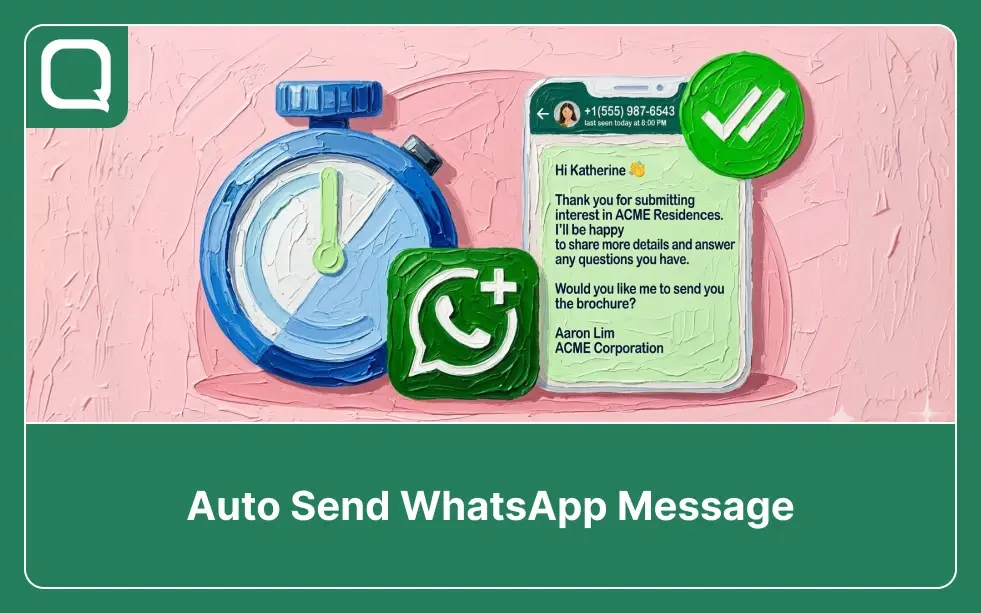
Auto-sending WhatsApp messages solves this. When set up correctly, your business responds immediately at any hour, follows up with customers at the right time, and delivers scheduled campaign messages without anyone needing to be online at send time. The result is a customer experience that feels responsive and professional, and a team that spends its time on conversations that genuinely need human judgment.
This guide covers every method available for auto-sending WhatsApp messages in Malaysia in 2025-2026, from the native WhatsApp Business App features all the way to API-powered automation at scale.
What Does Auto Send WhatsApp Message Actually Mean?
The phrase “auto send WhatsApp message” covers several different capabilities that businesses in Malaysia commonly use. They are not all the same thing, and understanding the distinction helps businesses choose the right approach for their specific situation.
At the most basic level, auto-sending refers to any message that WhatsApp delivers automatically without a human manually typing and hitting send. This includes automatic greetings when a customer messages for the first time, away messages outside business hours, scheduled broadcast campaigns that deliver at a set time, and trigger-based messages that fire when a specific customer action occurs.
Each of these works differently, requires different setup, and is suited to different business objectives. The WhatsApp Business App handles the simplest two. The WhatsApp Business API handles all of them, including the more sophisticated automation that growing businesses in Malaysia actually need. With that foundation clear, the logical starting point is understanding what the standard app can and cannot do.
What the WhatsApp Business App Can Auto-Send
The WhatsApp Business App is a free product from Meta. It gives businesses in Malaysia a professional WhatsApp presence without any technical setup. It includes two native auto-send features that are genuinely useful for small businesses managing low message volumes.
Understanding what these features actually do, and where they stop, prevents businesses from over-investing in the standard app when they have already outgrown it.
1. Greeting Messages
A greeting message is sent automatically when a customer contacts your business for the first time, or after 14 days of inactivity. It fires immediately when the customer sends their first message. There is no delay. No manual action is needed from your team.
A well-written greeting message does three things: it acknowledges the customer immediately, it tells them what the business can help with, and it gives them a next step. A simple example for a business in Malaysia might read: “Hi, terima kasih kerana menghubungi kami. Kami boleh bantu dengan pesanan, pertanyaan produk, dan sokongan pelanggan. Bagaimana kami boleh membantu anda hari ini?” Offering quick-reply buttons below the message helps customers self-direct and reduces the back-and-forth that generic inquiries create.
Greeting messages are the minimum viable auto-send setup for any business in Malaysia using WhatsApp. They ensure no customer is left staring at an empty chat. However, they are a static, one-way response. They do not adapt based on what the customer says or what time it is.
2. Away Messages
An away message sends automatically when a customer contacts your business outside of the hours you configure. It is the WhatsApp equivalent of an out-of-office reply. It acknowledges the timing, sets an honest expectation for when the customer will hear back, and provides something useful in the meantime.
A practical away message for a business in Malaysia might read: “Terima kasih kerana menghubungi kami. Pasukan kami sedang tidak bertugas sekarang. Kami beroperasi Isnin hingga Jumaat, 9 pagi hingga 6 petang. Kami akan membalas mesej anda secepat mungkin esok.” Adding a FAQ link or an emergency contact option further reduces customer frustration for urgent cases.
3. The Hard Limits of the Native App
The WhatsApp Business App has no broadcast scheduling feature. Every broadcast goes out immediately when you tap send. There is no queue, no calendar, and no “send later” option. The broadcast list caps at 256 contacts, and every recipient must have your number saved. There is no trigger-based messaging, no CRM integration, and no way to automatically follow up based on customer behavior.
These limits are not bugs. They reflect what the standard app was designed for: small businesses with low message volumes and simple communication needs. For businesses in Malaysia that have grown beyond that profile, the WhatsApp Business API is the only path forward. That is where auto-send capability becomes genuinely powerful.
What the WhatsApp Business API Enables for Auto-Send
The WhatsApp Business API is the enterprise-tier infrastructure for WhatsApp business messaging. It is not an app you download. It is a programmatic interface that connects WhatsApp to external platforms, automation systems, and backend data through an official Business Solution Provider (BSP).
For businesses in Malaysia that want to auto-send messages at scale, the API removes almost every constraint that the standard app imposes. It also introduces capabilities the standard app cannot offer at any configuration level. The three most important auto-send capabilities that the API unlocks are scheduled broadcast, trigger-based messaging, and chatbot automation.
1. Scheduled Broadcast Messages
Scheduled broadcast is the most commercially impactful auto-send capability the API provides. It lets businesses separate campaign configuration from campaign delivery entirely, removing the dependency on team availability at send time.
Scheduled broadcast via the API lets businesses configure a campaign message, an audience segment, a delivery time, and a timezone, then schedule it to send automatically at the specified moment. No device needs to stay online. No team member needs to be available at send time. The platform delivers the message server-side at exactly the configured time.
Scheduled broadcast handles proactive outreach. The next auto-send capability handles the equally important task of responding to what customers do.
2. Trigger-Based Auto-Send Messages
Where scheduled broadcast is planned in advance, trigger-based messaging is responsive. It fires at the moment that is most relevant to the individual customer, which is often the most commercially powerful moment to communicate.
Trigger-based messages fire automatically when a specific customer action or backend event occurs. They are not scheduled for a fixed time. Instead, they respond to what the customer does.
This is the form of auto-send that creates the most commercially valuable WhatsApp touchpoints. The message arrives at exactly the moment it is most relevant to the customer. For businesses in Malaysia running high-volume customer operations, trigger-based messaging is the automation layer that makes WhatsApp customer service both scalable and genuinely responsive.
The broadcast sends the right message at the right planned time. Trigger-based sends the right message at the right behavioral moment. The third capability, chatbot automation, handles real-time conversation responses that neither broadcast nor triggers can address.
3. AI Chatbot Auto-Responses
When a customer replies to a broadcast or sends an inbound message outside business hours, neither scheduled broadcast nor trigger-based automation can handle the conversation that follows. That is the chatbot’s role.
Unlike the greeting message in the standard app, a WhatsApp chatbot connected via the API can conduct a real conversation. It understands what the customer says, detects their intent, responds contextually, and routes to a human agent when the conversation requires judgment that automation cannot provide.
The combination of scheduled broadcast, trigger-based messaging, and chatbot auto-response forms a complete auto-send infrastructure. Each type handles a different part of the customer communication lifecycle. Together, they ensure that no message goes unanswered, no follow-up is missed, and no campaign is dependent on someone being at their desk at the right time.
Auto-Send Use Cases: How Businesses in Malaysia Apply This in Practice
Understanding the theory becomes more useful when applied to real business contexts. The following examples illustrate how businesses across different industries in Malaysia use auto-send WhatsApp messages to drive specific outcomes in 2025-2026.
1. E-Commerce: Order Lifecycle Notifications (Klang Valley)
For e-commerce businesses, order lifecycle communication is one of the highest-volume, highest-frequency auto-send use cases. Every purchase creates multiple touchpoints that customers expect to receive automatically.
Each message arrives at exactly the right moment without any manual action. During peak periods like 11.11, 12.12, or Hari Raya sales events, this automation handles thousands of simultaneous order updates without any additional team workload. Customer satisfaction improves because buyers feel informed. Support volume decreases because proactive updates reduce “where is my order” inquiries.
For more on how outbound message templates support these flows, the template structure for transactional auto-send messages is worth reviewing before building the workflow.
The same trigger-based logic applies in healthcare, where the timing of auto-send messages directly affects patient attendance and clinic efficiency.
2. Healthcare: Appointment Reminders and Follow-Ups (Klang Valley Clinics)
No-show rates are a direct revenue and operational problem for clinics. Auto-send appointment reminders address this without adding to staff workload.
Private clinics and specialist centres across the Klang Valley use trigger-based auto-send to reduce no-show rates. When a patient books an appointment, the system immediately sends a confirmation message. A reminder auto-sends 24 hours before the appointment. A second reminder auto-sends 2 hours before. After the visit, a follow-up message auto-sends with post-visit instructions or a feedback request.
The structured follow-up pattern that works for healthcare applies equally to property, where the gap between initial interest and purchase decision is often weeks or months long.
3. Property: New Launch Notifications and Lead Follow-Up (Johor Bahru and Selangor)
For property developers, timing and lead qualification are the two variables that most directly affect sales conversion. Auto-send handles both simultaneously.
Property developers in Johor Bahru and Selangor use scheduled broadcast to announce new project launches to opted-in prospect lists. The broadcast is configured during office hours and scheduled for Tuesday or Wednesday evening, when research consistently shows Malaysian property buyers are most actively reviewing options.
The broadcast includes a project image, a brief specification summary, and CTA buttons for “Register Interest” and “Request Price List.” When a prospect taps either button, a trigger fires that either sends an automated price list document or routes the prospect to a chatbot that collects their preferred unit type, budget, and timeline. High-intent prospects are automatically escalated to a sales consultant with the qualification data already captured.
This combination of scheduled broadcast and trigger-based follow-up is the same pattern that works effectively for F&B businesses managing weekly promotion cycles.
4. F&B: Weekly Promotion Campaigns (Penang and KL)
For F&B businesses, consistent weekly promotion is a proven driver of repeat visits. Auto-send makes that consistency achievable without manual effort every week.
Restaurant groups in Penang and Kuala Lumpur schedule weekly promotion broadcasts to opted-in customer lists every Thursday evening. The message includes the weekend special, a food image, and a quick-reply button to make a reservation. The platform delivers it at 7pm without anyone from the marketing team needing to be at their desk.
The same scheduling and response automation logic scales effectively for financial services, where the stakes of missed follow-up are higher and the volume of contacts to manage is larger.
5. Financial Services: Policy Reminders and Re-Engagement (KL and Selangor)
For financial services businesses, the cost of a missed renewal or lapsed policy is significant. Trigger-based auto-send ensures no renewal window closes without a structured follow-up sequence.
Insurance agencies and wealth management firms in KL and Selangor use trigger-based auto-send to manage policy renewal alerts. The system queries the CRM 45 days before each policy expiry date and fires a personalized WhatsApp message to the policyholder. The message references the specific policy, the renewal date, and the next step.
Customers who respond are routed to their assigned advisor. Customers who do not respond receive a second auto-send at 30 days and 14 days before expiry. This structured follow-up sequence happens automatically across thousands of policies simultaneously, without any advisor needing to manually track renewal dates or remember to follow up.
Across all five industries, the pattern is consistent. Auto-send works because it removes the dependency on manual timing and human availability. But it only works safely when businesses follow the compliance requirements that govern automated WhatsApp messaging.
Compliance Requirements for Auto-Sending WhatsApp Messages in Malaysia
Auto-sending WhatsApp messages requires following specific rules that apply to all businesses in Malaysia using the API. These are not optional guidelines. Violations result in account restrictions, rate limiting, or permanent account suspension.
1. Explicit Opt-In Is Required
Opt-in is the single most important compliance requirement for auto-send WhatsApp messages. Without it, every other compliance measure is irrelevant because the messages should not be sent in the first place.
Every recipient of a business-initiated auto-send message must have explicitly consented to receive WhatsApp communications from the business. This consent must be specific to WhatsApp as a channel.
Businesses in Malaysia operating under the Personal Data Protection Act (PDPA) must document consent records with timestamps. This documentation is both a WhatsApp policy requirement and a legal protection in the event of a regulatory inquiry.
2. All Outbound Messages Require Approved Templates
Template approval is not a bureaucratic formality. It is the mechanism WhatsApp uses to ensure every proactive business message has been reviewed before it reaches a customer.
Template approval typically takes 24 hours for utility and authentication templates. Marketing templates may take longer and require a specific, valuable offer clearly identified with the business name. Getting templates approved before building automation workflows prevents the launch delays that unapproved templates cause.
With templates approved and opt-ins in place, the third compliance factor determines how much volume your auto-send system can sustain.
3. Quality Rating Affects Auto-Send Limits
The quality rating system is WhatsApp’s enforcement mechanism for message relevance. Businesses that treat auto-send as a volume exercise rather than a relevance exercise eventually hit this limit.
WhatsApp monitors recipient responses to every automated message. High block rates and spam reports reduce the account’s quality rating. A lower quality rating directly reduces the daily sending limit, which restricts the volume of auto-send messages the business can deliver. Sending relevant, expected messages to genuinely opted-in audiences is the fastest path to maintaining high quality ratings and scaling auto-send capacity over time.
4. Honor Opt-Out Requests Immediately
Opt-out management is the final and most operationally demanding compliance requirement. Without a system to handle it, honoring opt-outs at scale is nearly impossible.
Every recipient of an auto-send message must have a clear way to opt out. A customer who replies “STOP” or requests removal must be excluded from future automated messages immediately. For businesses in Malaysia managing large opted-in lists, automated opt-out management through a platform like Qiscus ensures no contact is messaged after requesting removal.
Following all four requirements is not complicated for businesses using the right platform. It is the baseline operating standard that keeps an auto-send program running long-term without account restrictions or compliance exposure.
How Qiscus Enables Auto-Send WhatsApp Messages at Scale in Malaysia
Qiscus is an official WhatsApp Business Solution Provider (BSP) in Malaysia and a globally registered Meta partner. Qiscus gives businesses in Malaysia the complete infrastructure to auto-send WhatsApp messages across every capability: scheduled broadcasts, trigger-based notifications, chatbot auto-responses, and compliance management, all from a single platform connected to the WhatsApp Business API.
1. Scheduled Broadcast via Qiscus WhatsApp Broadcast
Qiscus WhatsApp Broadcast lets marketing teams configure audience segments, approved templates, delivery times, and timezone settings in one workflow. The platform delivers campaigns server-side at the scheduled time without requiring any device to stay online or any team member to be available at send time. Every broadcast reaches only opted-in contacts with a Meta-approved template, maintaining full compliance with WhatsApp’s messaging policies.
This means businesses in Malaysia can plan a full month of campaign broadcasts in a single session and let the platform execute every delivery automatically at the optimal moment for each audience segment.
2. Trigger-Based Automation via Qiscus AgentLabs
When auto-send needs to respond to customer behavior rather than a fixed schedule, Qiscus AgentLabs handles the trigger logic and message delivery automatically.
Qiscus AgentLabs enables businesses to build automated message flows that fire based on customer actions, time intervals, or CRM events. Order confirmations, appointment reminders, trial activation sequences, renewal alerts, and post-purchase follow-ups all run automatically once the workflow is configured. Message performance is tracked in real time, allowing businesses to identify and address quality issues before they affect account limits.
For businesses managing inbound conversation volume alongside outbound auto-send, a unified conversation inbox is the next essential component.
3. AI Chatbot Auto-Responses via Qiscus AgentLabs
When inbound messages arrive from auto-send campaigns or organic customer contact, the chatbot layer handles the first-response volume automatically so human agents focus only on conversations that need them.
Qiscus AgentLabs also deploys AI-powered chatbot flows that activate on inbound messages, whether from a scheduled broadcast response or an organic customer inquiry. The chatbot greets the customer in context, qualifies their intent, answers routine questions, and routes complex cases to the right human agent automatically. For businesses in Malaysia managing hundreds of daily WhatsApp inquiries, this automation layer removes the manual burden from the first-response layer entirely.
4. Template Management and Compliance
Every auto-send message requires an approved template. Managing that approval process independently is time-consuming and error-prone. Qiscus handles it on behalf of client businesses.
Qiscus manages the full message template lifecycle on behalf of client businesses: creation, Meta submission, approval tracking, and version updates. Businesses in Malaysia do not need to navigate Meta’s template review process independently. Every auto-send message delivered through Qiscus uses a properly reviewed and approved template.
Additionally, Qiscus handles opt-in documentation and opt-out automation, ensuring that every auto-send workflow operates within WhatsApp’s policy requirements and Malaysia’s PDPA obligations.
5. Unified Inbox via Qiscus Omnichannel Chat
Auto-send campaigns generate inbound responses. Without a structured inbox to manage those responses, the volume they create becomes its own operational problem.
Qiscus Omnichannel Chat centralizes every automated message conversation alongside manual messages from Instagram, Facebook Messenger, LINE, Telegram, and 20-plus other channels. When a scheduled broadcast or trigger-based message generates a response, the conversation routes automatically to the right agent with full context.
Auto-send WhatsApp messages are most powerful when they are part of a connected system where broadcast, automation, human agents, and analytics all work together. Qiscus provides that system for businesses in Malaysia that are ready to build it.
Auto-Send WhatsApp Message with Qiscus
Setting up auto-send WhatsApp messages correctly is not about reducing effort. It is about building a communication system that operates reliably at any volume, at any hour, without depending on individual team members being available at the right moment.
Businesses in Malaysia that build this foundation properly, using the WhatsApp Business API, well-designed automation flows, properly approved templates, and a platform that connects every layer together, create a customer communication capability that improves every commercial metric that matters: response speed, conversion rate, customer satisfaction, and team efficiency.
The businesses that treat auto-send as a simple on-off switch will get simple results. The businesses that treat it as a communication architecture will build something that compounds in value over time.
Talk to our team and start setting up WhatsApp auto-send with Qiscus today.
Frequently Asked Questions About Auto-Send WhatsApp Messages in Malaysia
Yes, but only in a limited way. The WhatsApp Business App supports two auto-send features: greeting messages (triggered on first contact) and away messages (triggered outside business hours). Both are reactive and static. For scheduled broadcasts, trigger-based follow-ups, and chatbot auto-responses, the WhatsApp Business API through an official BSP like Qiscus is required.
No. Third-party tools that automate the WhatsApp consumer app interface violate WhatsApp’s Terms of Service. Using them risks account restriction or permanent suspension. The only safe and compliant way to auto-send WhatsApp messages at scale is through the official WhatsApp Business API accessed via an authorized BSP.
Only for broadcasts sent through the WhatsApp Business App native broadcast feature. API-powered auto-send messages do not require recipients to have the number saved. Every message delivers as a private individual chat regardless of whether the contact has saved the business number.
Every recipient must have explicitly consented to receive WhatsApp communications from your business. Consent must be documented with timestamps. Opt-out requests must be processed immediately. Businesses using Qiscus have opt-in documentation and opt-out automation built into the platform, which addresses the core PDPA compliance requirements for automated WhatsApp messaging.
Basic API onboarding through Qiscus typically takes one to two weeks, including Meta Business Manager verification, phone number registration, and initial template submissions. Building and testing the auto-send workflows, including chatbot flows and trigger integrations, takes additional time depending on complexity. Most businesses in Malaysia live with their first automated workflow within three to four weeks of starting the onboarding process.