AI Agents represent a shift from systems that respond to systems that act—software that doesn’t just wait for commands, but can execute tasks, make decisions, and improve autonomously.
As this technology becomes more accessible and mature, businesess are turning to AI Agents to reduce labor bottlenecks, accelerate workflows, and elevate human capability—unlocking new levels of productivity without proportional increases in headcount.
What Is an AI Agent?
At its core, an AI Agent is a software entity that can act autonomously—not just respond to instructions but interpret context, decide what to do, and execute tasks across systems.
Unlike traditional automation, which follows rigid rules, AI Agents are designed to:
- Understand inputs (text, data, voice, signals)
- Reason about goals or intent
- Take the next best action
- Learn from outcomes and improve
Think of it as a digital workforce: not a script, not a chatbot, but an intelligent collaborator that can handle routine work, coordinate processes, and support humans in real time.
This doesn’t mean replacing people—it means shifting software from a passive tool to an active participant in operations, capable of driving outcomes with minimal supervision.
How AI Agents Work
AI Agents operate by combining several capabilities that enable autonomous action rather than scripted responses. Instead of waiting for human instruction, they make sense of information, decide what to do, and execute tasks that move work forward.
1. Perception
AI Agents begin by perceiving their environment, capturing inputs from text, voice, images, or structured data. They interpret signals dynamically, rather than relying on predefined commands, extracting meaning, intent, and relevant information in real time.
This ability to understand context allows them to operate effectively in messy, unstructured environments, where traditional automation would fail.
2. Reasoning
Once a situation is understood, AI Agents reason through what should happen next. This involves evaluating context, goals, constraints, and potential outcomes.
Reasoning is what enables AI Agents to make judgment calls, prioritize tasks, and choose actions aligned with desired results — turning them into decision-making systems, not just automation scripts.
3. Action
After making a decision, AI Agents take direct action across systems. This could mean updating a database, sending notifications, triggering workflows, or orchestrating multi-step processes.
The ability to act autonomously is what turns insights into outcomes, enabling faster execution and reduced manual work.
4. Learning
AI Agents don’t just execute instructions — they learn from experience. By analyzing feedback and patterns, they improve performance over time, refining predictions, reducing errors, or adapting to new business rules.
Learning transforms them from static automation into adaptive systems that become more valuable the longer they operate.
5. Collaboration
AI Agents rarely operate in isolation. They frequently collaborate with humans — handling routine work and escalating edge cases when necessary. This creates a hybrid model where agents handle the predictable and humans manage the exceptional, leading to a smarter allocation of time, attention, and talent.
Core Benefits of AI Agents for Businesses
AI Agents are gaining attention because they don’t just automate tasks — they enable businesses to operate faster, smarter, and with less friction. Their impact spans productivity, scalability, and strategic decision-making, allowing businesses to achieve more without simply adding more people or tools.
1. Productivity and Efficiency
AI Agents handle repetitive, rule-based work at scale — from data entry to workflow execution — freeing employees to focus on tasks requiring creativity, expertise, or complex judgment. This shift from manual effort to autonomous execution enables teams to deliver more output with the same or fewer resources, while reducing operational bottlenecks.
2. Faster Execution and Responsiveness
Because AI Agents act in real time and don’t fatigue, they can respond instantly to events, escalate issues, and process workloads much faster than traditional workflows.
This leads to quicker turnaround times, reduced delays, and more consistent operational performance, especially in environments where speed is a competitive factor.
3. Consistency and Accuracy
Unlike humans, AI Agents don’t experience errors caused by distraction, fatigue, or interpretation gaps. They execute tasks with predictable, repeatable accuracy. This helps businesses maintain standardized quality, reduce risk, and ensure compliance, even as operations scale.
4. Scalability Without Additional Headcount
Businesses often struggle to scale workflows because hiring, onboarding, and managing staff becomes expensive and time-consuming. AI Agents scale capacity on demand without proportional increases in cost, enabling organizations to grow operations smoothly and sustainably.
5. Better Use of Human Talent
When routine work is offloaded to AI Agents, employees can concentrate on activities that create value — strategic planning, innovation, relationship-building, and complex problem-solving.
The result is a workforce that is more engaged, more productive, and better aligned with business priorities.
6. Data-Driven Insight and Optimization
AI Agents can extract trends and patterns from operational data, offering insights into inefficiencies, customer behavior, or process failures. This transforms raw data into actionable intelligence that informs decisions, drives optimization, and supports continuous improvement.
Challenges and Considerations
While AI Agents offer significant value, adopting them requires thoughtful planning. Businesses must balance ambition with operational reality, ensuring that automation supports business goals rather than introducing new risks or complexity.
1. Context and Edge Cases
AI Agents can struggle with ambiguous requests, incomplete information, or unfamiliar scenarios. Without proper safeguards, they may produce inaccurate or unhelpful outputs. Businesses need clear escalation paths and human oversight to handle exceptions effectively, ensuring that autonomy doesn’t compromise quality.
2. Data Privacy and Security
AI Agents often require access to sensitive information to perform tasks. Mishandling data can lead to privacy violations, regulatory penalties, and reputational harm. Businesses must enforce robust data governance practices, including access controls, encryption, and compliance with relevant regulations.
3. Integration Complexity
AI Agents need to interact with existing systems, platforms, and workflows. Integrating them into legacy environments can be technically challenging, time-consuming, or costly. A practical approach is to start small, pilot specific workflows, and expand gradually, rather than attempting full-scale integration immediately.
4. Trust and Acceptance
Employees may resist AI adoption if they perceive it as a threat to their role, while end-users may prefer human interaction for certain tasks. Leaders should position AI Agents as tools that augment work, not replace people, and foster transparent communication to build trust.
5. Ongoing Maintenance and Improvement
AI Agents are not “set-and-forget” systems. They require ongoing monitoring, tuning, and updates to reflect new rules, processes, and business needs. Treating AI as a living system that evolves over time is critical to maintaining accuracy, performance, and alignment with organizational goals.
How AI Agents Transform Business Operations
AI Agents are not just incremental improvements to existing tools — they enable businesses to redesign how work gets done, shifting from manual execution to autonomous, adaptive systems. Their impact spans customer experience, operations, sales, analytics, and workforce performance, delivering both efficiency and strategic agility.
1. Customer Experience & Support
AI Agents provide 24/7 responsiveness, offering personalized interactions, quick answers, and faster resolution for routine requests. This reduces waiting time, improves satisfaction, and keeps customers engaged across channels.
By offloading high-volume inquiries, businesses can manage spikes in demand without overwhelming human teams, leading to lower backlog and higher CSAT with less operational strain.
2. Operations & Back Office
Much of business operations is consumed by repetitive administrative work — data entry, validation, documentation, and process routing. AI Agents automate these activities at scale, completing them accurately and consistently.
This reduces operational friction and helps businesses maintain productivity without expanding headcount, resulting in lower administrative cost and more scalable processes.
3. Sales & Marketing
AI Agents can support growth functions by qualifying leads, personalizing outreach, and executing campaigns based on customer behavior. They analyze intent, segment audiences, and trigger tailored actions automatically.
This enables teams to generate more opportunities with fewer resources, driving higher conversion and improved ROI without expanding sales or marketing manpower.
4. Analytics & Reporting
AI Agents can continuously monitor, analyze, and report on key business metrics, transforming raw data into actionable insights without manual intervention.
Real-time intelligence enables managers to make faster, data-driven decisions, identify bottlenecks, and track performance more accurately — improving visibility and operational responsiveness.
5. Workforce Productivity
AI Agents don’t replace people — they remove cognitive and administrative overhead, allowing employees to focus on high-value tasks that require creativity, judgment, and human connection.
This shift results in a workforce that is not only more productive, but also more engaged, because effort is spent on work that drives impact rather than repetitive manual tasks.
How Businesses Can Start Using AI Agents
Adopting AI Agents doesn’t require a radical overhaul from day one. The most successful implementations start with small, controlled experiments that deliver quick wins and build confidence over time.
The goal is not just to deploy technology, but to create smarter, more autonomous workflows that enhance productivity and decision-making.
1. Identify High-Volume, Repetitive Tasks
Begin by pinpointing work that is repetitive, rule-based, and time-consuming — such as data entry, form submissions, status updates, or routine inquiries.
These tasks typically consume a disproportionate amount of employee time despite being low-value from a strategic perspective, making them ideal candidates for automation.
2. Select Tools That Support Autonomy
Not every system marketed as “AI” is capable of autonomy. Many tools are limited to scripted responses or basic workflow triggers. Look for platforms designed for reasoning, task execution, and integration with business systems, rather than simple chatbot functions.
For example, Qiscus AgentLabs offers AI Agents that can access knowledge bases, interpret intent, execute tasks, and support multi-step workflows — moving beyond basic conversation automation.
3. Pilot One Workflow
Choose a single workflow to automate first. This allows teams to experiment, troubleshoot, and optimize without disrupting wider operations. Pilots are most effective when they are narrow, measurable, and high-impact, such as automating inquiry handling, internal routing, or report generation.
4. Measure Outcomes
Track performance indicators such as time saved, reduced errors, cost efficiency, or improved customer outcomes. Quantifying results is essential for building a business case and gaining stakeholder support.
Platforms like Qiscus AgentLabs typically include analytics dashboards that help measure performance, track accuracy, and surface optimization opportunities.
5. Scale Gradually
Once a pilot has proven value, expand into adjacent workflows or departments — for example, moving from routine data handling to back-office reporting or customer follow-ups. Scaling in phases ensures that AI Agents remain aligned with business needs, without overwhelming teams or systems.
6. Build Human–AI Collaboration
Define how work is shared between humans and AI Agents, including escalation rules, handoffs, and exceptions. This ensures that AI handles predictable tasks efficiently, while humans step in only when context, judgment, or empathy is needed.
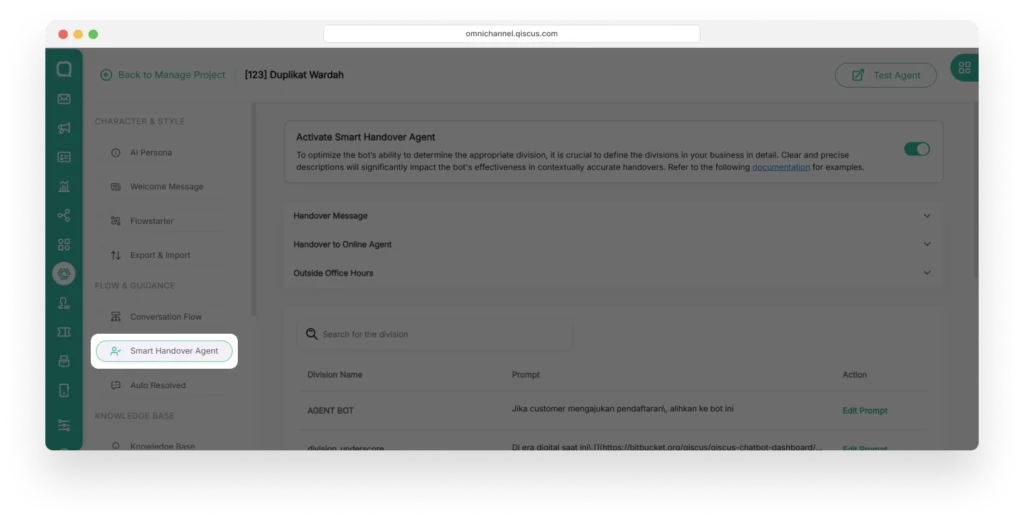
To support this workflow, Qiscus AgentLabs includes a handover agent feature that enables seamless transition from AI to human agents, passing context along so work continues smoothly. This hybrid model accelerates routine work while maintaining high-quality human support when it matters most.
Build Smarter, Faster Operations with AI Agents
AI Agents mark a shift from software that reacts to systems that act, learn, and collaborate. They help businesses work faster, scale efficiently, and free people from repetitive tasks so they can focus on higher-value work.
As more businesses explore this shift, tools like Qiscus AgentLabs make adoption practical with AI Agents that can execute tasks, integrate with systems, and seamlessly hand over to humans when needed.
Want to see what AI Agents can do for your business? Contact Qiscus today to explore solutions or request a demo of AgentLabs.