Naturally, businesses want to leverage that channel to send notifications: order updates, appointment reminders, promotional offers, and more.
But here’s where things get complicated. WhatsApp is not SMS. It is not an email. And it is definitely not a channel you can blast messages to without consequences.
Businesses that treat WhatsApp push notifications as a free-for-all marketing channel are not just violating WhatsApp’s own policies in the United States, they may also be walking into serious legal exposure under federal regulations like the TCPA and state-level laws like the CCPA.
This article cuts through the noise. A clear, honest picture of what WhatsApp business-initiated messaging actually is and how to use it the right way.
What Are WhatsApp Push Notifications?
Let’s get the terminology right first, because it matters for compliance.
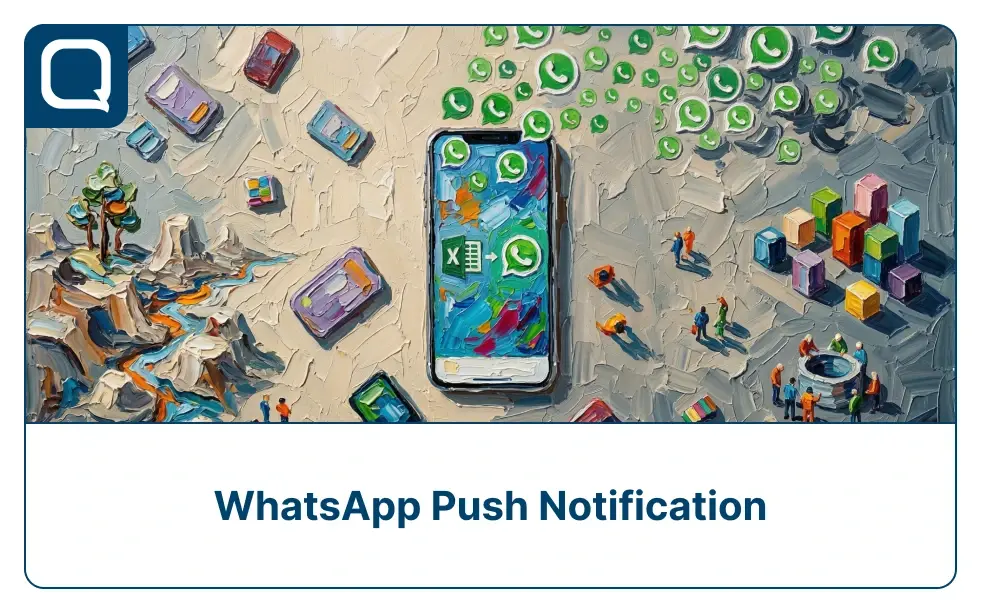
In WhatsApp’s framework, what businesses commonly call “push notifications” are formally classified as business-initiated messages, then, a proactive messages sent by a business to a customer outside of an active conversation.
WhatsApp distinguishes these from customer-initiated conversations (where the customer messages first) because the rules around them are fundamentally different.
Business-initiated messages on WhatsApp can only be sent using pre-approved message templates through the WhatsApp Business Platform (the API tier, not the standard app). These templates must be submitted to and approved by Meta before use.
They are categorized into specific use cases, and the category determines both the content rules and the pricing. Understanding this classification is the foundation of everything else in this article.
Why WhatsApp Push Notifications Outperform Other Channels
After understanding what WhatsApp push notifications are, the next step is recognizing why they have become a preferred channel for many businesses.
Compared to traditional channels like email and SMS, WhatsApp offers higher visibility, faster engagement, and more interactive communication, making it especially effective for time-sensitive and high-impact messaging.
1. Higher Open Rates and Faster Read Time
WhatsApp messages often achieve open rates above 90%, significantly higher than email’s typical 20–25%. More importantly, messages are usually read within minutes, making them ideal for urgent updates such as order confirmations, payment alerts, or reminders.
2. Strong Channel Relevance in SEA
In markets like Malaysia, the Philippines, and Singapore, WhatsApp is a primary communication platform. Customers are already active on WhatsApp daily, which makes it more natural and convenient for them to receive and respond to business messages.
This is why WhatsApp customer service has become the default standard for businesses in the region.
3. Rich and Interactive Message Formats
Unlike SMS, WhatsApp supports buttons, images, and quick replies, allowing businesses to create more engaging messages. These interactive elements make it easier for users to take action directly within the chat, improving overall engagement and response rates.
4. End-to-End Encryption as a Trust Signal
WhatsApp’s end-to-end encryption ensures that messages are secure and private. This is especially important for industries like fintech and healthcare, where trust and data security are critical to customer relationships. It’s one of the core advantages that WhatsApp Business API offers over unencrypted channels.
5. Channel Consolidation for Simpler Communication
WhatsApp can replace multiple channels such as email, SMS, and app push notifications. By consolidating communication into one platform, especially when managed through an omnichannel platform businesses can simplify operations while ensuring higher message delivery and visibility.
6. Higher ROI on Compliant Campaigns
When used correctly and in compliance with WhatsApp policies, push notifications can deliver strong returns. Businesses can reach customers more effectively, drive engagement, and track performance, creating a clear link between messaging efforts and business outcomes.
WhatsApp push notifications outperform other channels because they align with how modern customers communicate: fast, direct, and interactive. By leveraging WhatsApp, businesses can create more effective communication strategies while maximizing the impact of every message sent.
Why Businesses Get Banned on WhatsApp Business
Many businesses have discovered WhatsApp’s reach and engagement rates and approached it the same way they approach email blasts or SMS campaigns: collect contacts, write a message, send it at scale. That approach gets accounts banned and it happens faster than most people expect.
WhatsApp’s quality monitoring system is continuous and unforgiving. Every message your business sends is evaluated based on how recipients respond to it. If recipients are blocking your number, reporting your messages as spam, or simply not engaging, your quality rating drops.
A poor quality rating triggers rate limiting, restricting how many messages you can send per day. Sustained poor quality leads to account restriction or permanent suspension.
In 2024, WhatsApp banned over 92 million accounts globally for policy violations, the majority related to spam and unsolicited messaging. Losing your WhatsApp Business account doesn’t just disrupt a campaign.
It cuts off your entire customer communication channel overnight. This is exactly why understanding the difference between the standard app and the WhatsApp Business API matters, the rules, the limits, and the consequences are not the same.
And for US businesses specifically, the risks go beyond WhatsApp’s internal enforcement. There are federal laws to contend with.
Transactional vs. Marketing Messages: Why the Distinction Matters
WhatsApp categorizes business-initiated message templates into three types, and understanding the difference is essential both for compliance and for cost management. This distinction also directly affects your WhatsApp Business API pricing, each message category is billed differently.
1. Utility Messages (Transactional)
These are messages tied to an ongoing transaction or customer action — order confirmations, shipping updates, appointment reminders, payment receipts, account alerts. They are the most straightforward category from a compliance perspective because the customer has typically implied their interest by initiating the transaction.
Examples by industry:
- A fintech company in Singapore sending a transaction verification alert when unusual account activity is detected
- A healthcare provider in the Philippines sending an appointment confirmation and pre-visit instructions
- A logistics company in Malaysia sending a real-time delivery status update to a shipper
- A SaaS platform in the US sending a usage alert when a customer approaches their plan limit
Utility messages are lower risk from a spam perspective because they are expected, contextually relevant, and directly tied to something the customer did. However, opt-in requirements still apply, customers must have consented to receive notifications via WhatsApp.
2. Authentication Messages
These cover OTP (one-time password) messages and verification codes, used by banks, fintech companies, and any platform requiring identity verification. In markets like Singapore and Malaysia, WhatsApp OTP is increasingly preferred over SMS because of its end-to-end encryption and higher delivery reliability.
3. Marketing Messages
This category includes promotional messages, product announcements, re-engagement campaigns, and any message with a commercial intent that goes beyond a transactional update. Marketing messages on WhatsApp require the most stringent opt-in standards and carry the highest compliance risk.
For US businesses, sending marketing messages via WhatsApp without documented prior express written consent is a direct exposure to TCPA liability. The channel doesn’t change the law, what would be a violation via SMS is equally a violation via WhatsApp if the message is automated and promotional in nature.
Real Business Use Cases: WhatsApp Notifications Done Right
Across these examples, the common thread is not the industry, but the discipline behind how WhatsApp is used. Businesses aren’t sending messages to “stay top of mind”, they’re delivering timely, relevant updates that customers expect and value.
That’s what keeps engagement high, complaints low, and WhatsApp accounts in good standing while still driving measurable business outcomes.
1. E-Commerce: Order Lifecycle Notifications (Malaysia & US)
Shopee and regional e-commerce platforms in Malaysia use WhatsApp utility notifications to keep buyers informed throughout the purchase journey: order confirmed, payment received, shipped, out for delivery, delivered, refund processed. Each message is triggered by a transaction event, expected by the customer, and directly relevant to what they bought.
In the US, DTC brands on Shopify have begun integrating WhatsApp into their post-purchase notification flow, particularly for international shipments where SMS delivery is unreliable.
The customer opts in at checkout (“Send my order updates via WhatsApp”), and all subsequent shipping notifications are delivered through the channel. Open rates for these transactional messages consistently outperform email equivalents.
2. Healthcare: Appointment Reminders and Follow-Ups (Philippines & Singapore)
Private hospital groups in Manila and Singapore use WhatsApp appointment reminders to reduce no-show rates, a problem that costs healthcare providers significant revenue.
A patient books a consultation, opts in to WhatsApp notifications as part of the booking flow, and receives a confirmation message immediately, a reminder 24 hours before the appointment, and a post-visit follow-up with care instructions.
The consent here is clean and contextual: the patient actively chose the appointment, was presented with a clear opt-in at the point of booking, and receives messages directly relevant to their healthcare interaction. No spam risk. Full compliance.
3. Financial Services: Account Alerts and Fraud Notifications (Singapore & US)
Banks and fintech companies in Singapore use WhatsApp to deliver real-time transaction alerts. A customer makes a purchase above a threshold amount, and a WhatsApp message arrives within seconds: “A transaction of SGD 450 was made on your card at [Merchant]. Not you? Reply to this message immediately.”
This use case works precisely because it’s utility-first, consent-driven, and high-value to the customer.
In the US, wealth management firms and fintech startups are exploring similar models, with the critical caveat that TCPA consent documentation must be airtight before any automated WhatsApp message is sent.
4. Retail & Loyalty: Re-engagement Campaigns (Philippines & US)
Fashion retailers in the Philippines with established WhatsApp customer bases use marketing message templates to run re-engagement campaigns for lapsed customers.
The compliance infrastructure here is more demanding: explicit opt-in must be documented, message templates must be approved by Meta in advance, content must not be deceptive, and opt-out must be honored immediately.
Done correctly, these campaigns outperform email and SMS re-engagement by a significant margin. Done incorrectly by using purchased contact lists or skipping the opt-in requirement, they result in account bans and, for US businesses, potential TCPA exposure.
This is a common failure mode in broadcast messaging campaigns that skip the consent step.
5. B2B SaaS: Trial Activation and Onboarding Sequences (US & SEA)
SaaS companies targeting SMBs use WhatsApp notification sequences to guide trial users through activation steps.
A new user signs up, opts in to WhatsApp updates as part of the onboarding flow, and receives a structured sequence: welcome message, feature highlight on day 2. “Have you tried X?” prompt on day 4, and a human handoff to a sales rep if engagement signals indicate buying intent.
In conclusion, this sits in the grey zone between utility and marketing, which is why template category selection and approval is critical.
Getting the wrong category approved results in rejected templates; getting the right category approved with proper messaging results in a highly effective activation channel.
Integrating a WhatsApp chatbot at this stage can automate the early steps while preserving the human handoff for high-intent conversations.
3 Mistakes That Put Your WhatsApp Business Account at Risk
Most businesses that get their WhatsApp accounts restricted or face regulatory inquiry or fail on one of three points. These are the gaps that separate businesses that use WhatsApp push notifications safely from those that don’t.
1. Consent That Doesn’t Actually Meet the Standard
Businesses often believe they have valid consent when they don’t. Common examples:
- A phone number collected via a website form where the user didn’t specifically agree to WhatsApp messages
- An opt-in checkbox that was pre-checked by default
- Consent given for SMS marketing that is extended to WhatsApp without a separate, explicit WhatsApp-specific consent
- Purchasing contact lists from third parties and treating them as opted-in
For US businesses, none of these scenarios meet the TCPA’s prior express written consent standard for automated marketing messages. And none of them meet WhatsApp’s own opt-in policy. Both failures compound each other.
2. Message Templates That Don’t Match Their Approved Category
WhatsApp reviews templates at the time of submission, but the actual messages sent in production need to remain consistent with the approved category. A template approved as a utility message that is then used to embed promotional content creates both a policy violation risk and an account quality risk.
Template violations are among the most common reasons for account restrictions, a deeper understanding of how WhatsApp Business API inbound and outbound messaging works helps avoid this trap entirely.
3. No Systematic Opt-Out Management
Under the new TCPA rules effective April 2025, businesses must process opt-out requests within 10 business days, regardless of how the opt-out is communicated. Whether it’s a “Stop” reply to a WhatsApp message, an email request, or a phone call.
Without a system that centralizes opt-out management across channels, this 10-day window is almost impossible to honor at scale.
This is one of the strongest arguments for managing WhatsApp within a proper omnichannel customer service platform rather than in isolation.
How Qiscus Helps Businesses Send WhatsApp Notifications the Right Way
Sending WhatsApp push notifications compliantly at scale requires more than good intentions. It requires the right infrastructure and that’s exactly what Qiscus is built to provide.
Qiscus is an official WhatsApp Business Solution Provider (BSP) with deep expertise helping businesses across Southeast Asia and beyond implement compliant, effective WhatsApp messaging programs.
1. WhatsApp Business API Access with Template Management
Through Qiscus, businesses access the WhatsApp Business Platform with full support for message template creation, categorization, and submission. The Qiscus team helps clients select the correct template category, write content that meets Meta’s approval standards, and manage the template lifecycle as business needs evolve.
2. Opt-In Collection and Consent Documentation
Qiscus supports businesses in building compliant opt-in flows that meet both WhatsApp’s policy requirements and applicable regulations. Every opt-in is timestamped and documented. Creating the consent records that businesses need to demonstrate compliance in the event of a regulatory inquiry or account review.
3. Automated Messaging Flows with Quality Monitoring
Qiscus AgentLabs enables businesses to build automated WhatsApp notification sequences with built-in quality monitoring. Message performance is tracked in real time, allowing businesses to identify and address quality issues before they trigger rate limiting or account restrictions.
When combined with AI-powered customer service capabilities, the system can intelligently escalate conversations that need a human touch.
4. Omnichannel Opt-Out Management
Qiscus Omnichannel Chat centralizes customer communications across WhatsApp, email, Instagram, and 20+ channels into a single inbox.
This means opt-out requests received through any channel can be captured, processed, and honored within the compliance window, addressing one of the most operationally complex requirements of the updated opt-out rules.
5. WhatsApp Broadcast with Compliance Controls
Qiscus’s WhatsApp Broadcast feature enables businesses to send approved template messages at scale to opted-in audiences, with built-in audience segmentation, scheduling, and compliance controls. Businesses can manage opted-in lists, exclude opt-outs automatically, and track delivery and engagement metrics across campaigns.
Whether you’re a healthcare group in Singapore managing appointment notification flows, an e-commerce brand in the Philippines running loyalty campaigns, or a B2B SaaS company in the US building compliant onboarding sequences, Qiscus provides the infrastructure to do it right.
Maximize WhatsApp Push Notifications with Qiscus
WhatsApp business-initiated messaging is one of the most effective customer communication channels available today. The engagement rates are real. The business outcomes are real too.
The businesses that build their WhatsApp notification programs on proper consent, compliant templates, and systematic opt-out management will have a durable competitive advantage. The ones that cut corners will eventually pay — either through a banned account or a legal settlement.
The choice, ultimately, is about whether you want to build a real channel or a shortcut. Qiscus is built for businesses that want to build something real. Give us a call.